

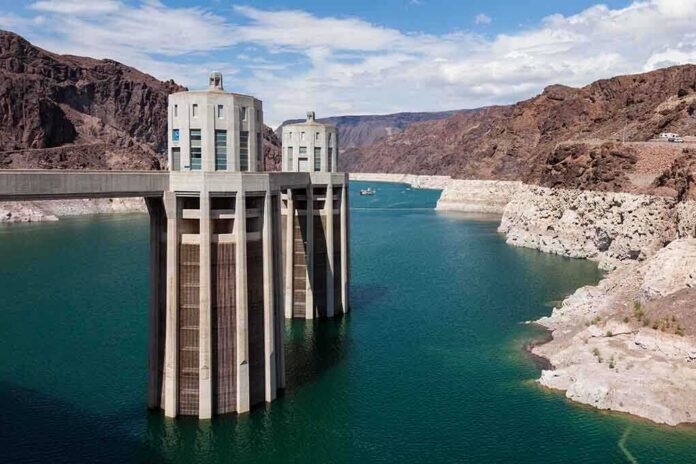
Lake Powell dropped to a new record low, tightening the vise on water and power for tens of millions across the Southwest.
Story Snapshot
- NASA reported Lake Powell hit a record-low elevation in early September 2026.
- Officials link the drop to a weak snowpack and poor runoff in the Colorado River Basin.
- Hydropower at Glen Canyon Dam faces growing risk if levels keep falling.
- Federal projections show both Lake Powell and Lake Mead at historic combined lows.
Record Low Confirmed by Satellite and Federal Data
NASA published satellite images showing Lake Powell at a record-low elevation in early September 2026, capturing a water surface near 3,517 feet above sea level. The images compare a near-full look from 2017 with the shrunken shoreline this year. A separate report summarized the same drop, tying it to a dry, warm winter that starved the river of snowmelt. A water database that tracks daily levels also showed readings in the 3,517-foot range in mid to late September.
Federal managers said the two largest Colorado River reservoirs, Lake Powell and Lake Mead, both reached record lows in recent weeks, leaving their combined storage at its weakest since before Powell began filling in the 1960s. That combined decline sets a wider context for Powell’s record. It shows a system under strain, not a one-off dip. Experts point to an ongoing mismatch between water used and water available, made worse by the recent snowpack failure.
Why the Water Dropped So Far, So Fast
NASA linked the fall to reduced seasonal snowmelt that turned into a trickle by late spring, cutting the flow that feeds the lake. Reporters and researchers echoed that finding, citing a record-low winter snowpack across the Upper Colorado River in 2025 to 2026 and weak runoff into both major reservoirs. This year’s weather shock landed on top of years of drought and heavy demand, creating a new floor for storage and pushing out old planning guardrails for river operations.
Numbers help show the trend. Lake Powell’s previous low was about 3,519.9 feet in April 2023. By August 2026, levels fell below that mark and kept sliding into September, when the recorded elevation touched about 3,517.24 feet in NASA’s reported image time frame. Local and media measurements placed daily values around 3,517 to 3,518 feet through mid and late September, confirming the prolonged dip rather than a brief blip.
Rising Risks for Cities, Farms, Tribes, and Power Users
Federal Bureau of Reclamation (Reclamation) officials warned that falling storage raises the chance of more delivery cuts to states and tribes that rely on the Colorado River, as well as risks to power from Glen Canyon Dam when the lake nears minimum generation levels. Regional managers described the system as in “uncharted” or “new” territory as rules collide with scarce supply and old promises made when the river ran higher. The new records forced talks about deeper, faster conservation across the basin.
Lake Powell Falls to 3,517 Feet, a New Record
Read the full story: https://t.co/kFpyEYZRBl
Lake Powell hit a record-low 3,517 feet in September 2026-two feet below the 2023 record-as megadrought and a failed snowpack threatened water and power for 40 million people.… pic.twitter.com/w94LEC0inm
— wondernews.now (@wondernews_now) September 23, 2026
Households and businesses feel that stress first in higher costs, tighter local limits, and more outages when water and power both thin out. Farmers face hard choices on which fields to fallow and which crops to keep. Cities must invest in fixes that take years, not months, like recycling, conservation, and new pipes. People on both the left and the right see a common failure: a federal system that waited too long to adjust, and now asks everyone to pay for that delay.
What Happens Next and What To Watch
Reclamation’s planning documents and recent projections make clear that repeated record lows are possible until the basin brings use in line with supply. That means tougher operating rules, stronger conservation, and coordination among states, tribes, and Mexico. Watch for updates on Lake Powell’s elevation through fall and winter, when storms can build or miss the needed snowpack. Also watch Glen Canyon Dam’s operating notes, since power generation thresholds concentrate the near-term risk.
Leaders will argue about causes and fixes, but the facts are plain. Lake Powell hit a new low, following a winter that failed to deliver mountain snow and spring flows. The twin reservoirs that anchor the river system are at historic combined lows. People who depend on this water and power now face higher stakes with less margin for error. That is not a partisan problem. It is a shared test of planning, prudence, and accountability.
Sources:
sciencedaily.com, science.nasa.gov, yahoo.com, lakepowell.water-data.com, denvergazette.com, usbr.gov
© newsalertdaily.org 2026. All rights reserved.