

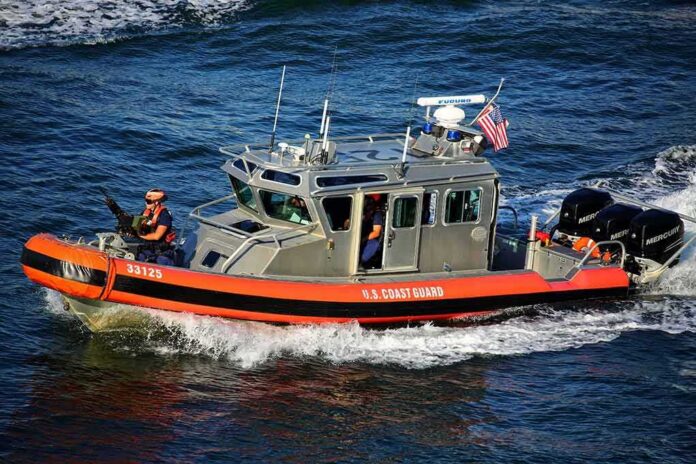
After 67 U.S. boat strikes and 221 people killed, officials admit the cocaine flow into America has barely budged.
Story Snapshot
- U.S. forces have bombed at least 67 small boats under Operation Southern Spear, killing about 221 people.
- A Drug Enforcement Administration review found the strikes have not reduced the amount of cocaine entering the United States.
- Drug cartels have shifted tactics, making the drug trade more flexible while traditional law enforcement tools grow weaker.
- Experts now question whether a lethal, secretive campaign run by the Pentagon is the right tool for a civilian drug problem.
Deadly Campaign, Limited Impact on Cocaine Supply
Since September 2025, the U.S. military has run a lethal campaign against small boats in the Caribbean Sea and the eastern Pacific Ocean, saying they carry narcotics toward the United States. Public data collected by researchers shows at least 67 boats struck in 63 attack events and about 221 people killed, including those missing and presumed dead. Yet a Drug Enforcement Administration assessment reviewed by reporters concluded the strikes have not reduced the amount of cocaine entering the country.
Trump administration officials promoted Operation Southern Spear as a way to “disrupt the flow of narcotics in the Western Hemisphere” from cartels the president labeled terrorist organizations. U.S. Southern Command videos show stealth aircraft and armed drones hitting small boats, which erupt in fireballs on the open ocean. These dramatic clips spread quickly online and are framed as victories against “narco-terrorists.” But cocaine remains widely available in many American cities, and prices and purity levels have stayed stable.
How Cartels Adapt While Traditional Policing Weakens
Law enforcement and drug experts say the strikes have mostly forced cartels to change how they move cocaine, not stop them. Traffickers now rely more on larger cargo ships, hidden loads in commercial containers, and overland routes through Central America and Mexico. These methods are harder to spot from the air and often fall outside the military’s narrow target list. At the same time, the quiet shift away from long investigations and seizures makes it harder for police and agents to build big criminal cases.
Past drug wars used raids, arrests, and courtroom trials to uncover entire networks. Those tools created records that judges, journalists, and the public could study. In this campaign, many strikes happen far from shore, based on secret intelligence, and leave almost no survivors. Little physical evidence is recovered at sea, and the government rarely shows proof beyond vague claims that boats were on “known trafficking corridors.” That leaves both conservatives and liberals asking a simple question: if the drugs are still coming, what exactly has been gained?
Cost, Legality, and the Growing Trust Gap
Analysts estimate Operation Southern Spear has cost several billion dollars, using advanced jets, drones, and ships to destroy speedboats run by poorly funded smugglers. For taxpayers who worry about overspending and debt, sinking small craft with high-end weapons looks like another case of the government throwing money at a problem without fixing it. For families hurt by addiction, the human toll at sea feels far removed from the daily reality of cheap cocaine on neighborhood streets.
Human rights groups and some legal scholars argue many of these killings may be extrajudicial executions, carried out without clear proof or due process. They note that the targets are civilian vessels, not warships, and that Congress never openly debated using military force this way in peacetime. Officials insist the strikes are “deliberate and legal” and follow the laws of armed conflict. But the Pentagon has said it cannot provide a full public accounting of all strikes, deepening suspicion among Americans already wary of a powerful “deep state” that operates in the shadows.
What This Says About a Government Struggling to Solve Problems
For many on the right and the left, this story feels familiar: a bold, high-profile operation, impressive technology, and big claims of success, yet little change in the real problem at home. Conservatives frustrated with decades of failed border and drug policies see another expensive program that does not stop the flow of narcotics or protect communities. Liberals angry about inequality and minority deaths see poor and brown people killed at sea while addiction treatment and local policing remain underfunded.
Operation Southern Spear shows how far the federal government will go to look tough, even when results are thin. Strikes are easy to count; boats destroyed and bodies killed make for simple talking points. But cocaine availability, overdose rates, and community safety are harder measures, and they have not clearly improved. As more Americans question whether elites in Washington are focused on headlines instead of solutions, the gap between flashy operations and everyday reality keeps growing—and with every strike, that trust gap widens a little more.
Sources:
feedpress.me, cnn.com, en.wikipedia.org, wola.org, aljazeera.com, ground.news, gulfnews.com, media.defense.gov, breakingdefense.com, cronkitenews.azpbs.org, jqas.org, youtube.com, defenseone.com, aa.com.tr, cfr.org, bbc.com, factcheck.org
© newsalertdaily.org 2026. All rights reserved.