
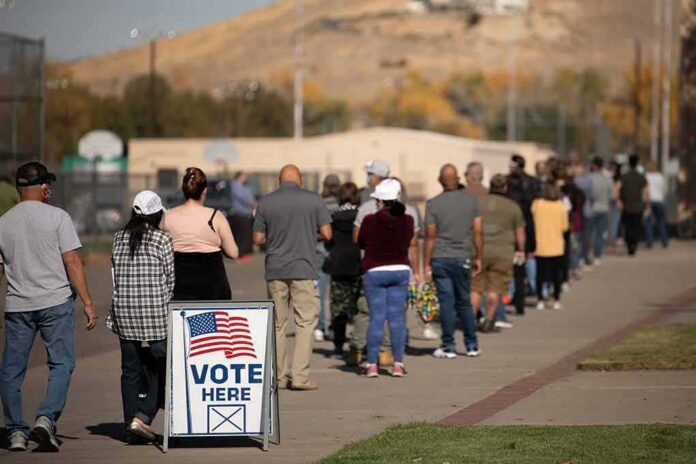
A federal judge said the Justice Department likely crossed a legal line by pressuring California election officials to set aside voters’ ballots days before the midterms.
Story Highlights
- A federal judge barred the Justice Department from demanding ballot segregation or threatening California officials with prosecution.
- The Justice Department said more than 20,000 “likely noncitizens” received mail ballots and sought rapid verification and segregation.
- California’s top election official called the federal list unreliable and refused to disenfranchise voters based on it.
- A federal appeals panel agreed segregation was not feasible without risking major disruption to the system.
Judge Blocks Demands and Threats Aimed at Ballot Processing
On October 30, United States District Judge Trina Thompson ordered the federal government to stop pressuring California election officials to separate or withhold ballots tied to people labeled “likely noncitizens.” The order also barred threats of criminal prosecution for not complying with those demands. The judge said the actions likely violated the Voting Rights Act’s ban on intimidation of people who help others vote, such as election workers and volunteers.
Earlier in the week, a different federal judge rejected the Justice Department’s emergency push to isolate thousands of ballots before counting began. That denial signaled courts’ concern about late election changes that can confuse voters and strain systems already under pressure. Together, the rulings sent a clear message: courts will not bless disruptive new rules, dropped at the last minute, without strong proof and a workable plan.
Justice Department’s Claim and California’s Response
The Justice Department said it worked with the Department of Homeland Security to flag more than 20,000 people it believed were likely noncitizens on California’s rolls. It asked the court to stop the state from tabulating those mail ballots until officials could verify each person’s citizenship status. The department framed this as a temporary hold, not a cancellation, citing federal laws that ban noncitizen voting in federal races.
California Secretary of State Shirley Weber pushed back. She said the federal list was unsupported and likely inaccurate, and she would not disenfranchise thousands based only on it. Her office reported that a small Los Angeles County review found notable accuracy problems in the federal data. She argued that the demand arrived too close to the election, making careful checks impossible without harming lawful voters.
Appeals Court Flags “Catastrophic” Risk to Election Systems
A federal appeals panel later underscored the practicality problem. The judges wrote there was no feasible way to identify and set aside the specific ballots without risking “catastrophic effects” on the wider system. That finding matched the district court’s concern that rushed sorting would bog down operations and risk mistakes that could silence eligible voters. The appellate language signaled strong judicial skepticism of sweeping, last-minute ballot holds.
The courts did not decide the ultimate truth about the 20,000 names. They focused on timing, proof, and process. The key point was simple: you cannot upend ballot handling without clear evidence and a safe method. That standard protects election workers from pressure that can look like coercion and protects voters from errors that are hard to fix once ballots are moving through the system.
Why This Matters Beyond One State
Election officials across the country face pressure from all sides. Some want faster purges of suspected ineligible voters. Others warn that broad data matches often misfire and sweep up citizens. Research shows noncitizen voting appears rare, while threats and harassment against election workers have grown since 2020. Courts often act as the guardrail against sudden changes that raise the odds of wrongful disenfranchisement.
Federal judge blocks Trump DOJ threats against election workers ahead of 2026 midterms
👉 SUBSCRIBE to Altas World News for the full story, plus our videos: https://t.co/gYYnbx1YYpBiden-appointed judge blocks Trump DOJ from warning election workers over ballots tied to… pic.twitter.com/gpnuuED1mw
— Altas World News (@Altas_WorldNewS) October 31, 2026
Both conservatives and liberals want fair elections. People on the right fear illegal voting dilutes their voice. People on the left fear voter suppression steals their voice. This case shows a third worry many now share: powerful officials may use blunt tools, late in the game, that shake faith in the system. The courts said not so fast. Demand proof. Protect process. Do not gamble with ballots when trust is already thin.
Sources:
cbsnews.com, washingtonexaminer.com, npr.org, justice.gov, link.springer.com
© newsalertdaily.org 2026. All rights reserved.