

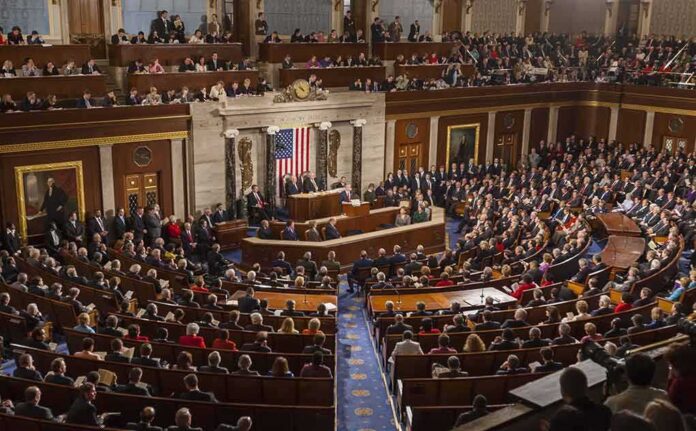
President Trump’s demand that senators “nuke” both their August vacation and the Senate filibuster to force through his SAVE America Act puts the rules of American democracy itself on the chopping block.
Story Snapshot
- President Trump is telling Senate Majority Leader John Thune not to let the Senate leave for August recess until the SAVE America Act passes or the filibuster is ended.
- The SAVE America Act is a strict national voting bill that would require proof of citizenship to register and photo ID to vote, changes critics say could block millions of legal voters.
- Trump wants Republicans to use the “nuclear option” to scrap the 60‑vote filibuster so they can pass the bill and other priorities with a simple majority.
- Thune and many Republicans resist changing the rule, saying the votes are not there and warning it could backfire on their party in the future.
Trump’s Ultimatum to Thune and the Senate
President Trump has issued one of his clearest threats yet to Senate Majority Leader John Thune: do not let the Senate “leave town” for its August recess until senators pass the SAVE America Act or eliminate the filibuster. Trump used his social media platform to say Thune should keep lawmakers in Washington and either advance the bill or “TERMINATE THE FILIBUSTER,” arguing Republicans could then quickly pass their whole agenda, including voting changes, the budget, and debt ceiling measures.
Trump has also used rallies and speeches to hammer the same point, telling supporters to call Thune and pressure him to move the bill. He has warned he will not sign other major legislation until Congress delivers on the SAVE America Act, turning the voting bill into his top demand for the Republican‑run Congress. This strategy ties routine governing tasks, like funding the government and lifting the debt ceiling, to a single hard‑line change in election rules, raising the stakes for both parties and for voters who depend on a stable government.
What the SAVE America Act Would Do to Voting
The SAVE America Act, which stands for Safeguard American Voter Eligibility, is a national voting overhaul built around proof‑of‑citizenship and voter ID rules. The bill would require Americans to show documents such as a valid United States passport or birth certificate when they register to vote, and then show photo ID when they cast a ballot, even in states that currently allow other forms of verification. It would also force states to send their voter rolls to the federal government and allow private parties to sue election officials if someone registers without proper proof of citizenship.
Supporters say these measures are needed to stop voting by people who are not citizens and to rebuild trust in elections after years of controversy. Trump has repeatedly claimed, without evidence, that Democrats are cheating and that voting by undocumented immigrants is “rampant,” and he points to the SAVE America Act as the fix. Voting experts and civil rights groups warn that the bill could block up to 20 million eligible American voters who lack easy access to passports, birth certificates, or other documents, hitting poorer citizens, older voters, and people who move often the hardest. They also note that forcing states to overhaul registration systems in the middle of an election cycle could create chaos and errors rather than clarity.
The Filibuster Fight: Nuclear Option vs. Senate Tradition
To get the SAVE America Act through the Senate, Trump is demanding more than persuasion; he wants Republicans to rewrite the chamber’s rules. Under current Senate practice, most major bills need 60 votes to clear what is called the legislative filibuster, a tradition meant to protect the minority party and encourage compromise. Because Democrats are united against the SAVE America Act and several Republicans have also balked, the bill cannot reach that 60‑vote mark and is stuck.
Trump is urging Thune and his caucus to use the so‑called “nuclear option,” a maneuver that would let a simple majority change Senate rules and end the filibuster for legislation. He argues that once the filibuster is gone, Republicans could pass the SAVE America Act and many other priorities with their bare majority, bypassing Democratic resistance. Thune has pushed back, saying his party does not have the votes to kill the filibuster and warning that such a move could damage the Senate and hurt Republicans when they are next in the minority. Other Republicans, including long‑time institutionalists, have echoed that concern, showing rare public resistance to a sitting Republican president’s demand.
Why This Clash Matters Beyond Party Politics
This standoff is about more than one bill or one vacation; it goes to the heart of how the country sets its rules and who gets a voice. Many Americans on both the right and the left already feel that Washington is run by elites who protect their own power first and deal with real problems later. Trump’s push to tie government funding and debt decisions to a single voting bill feeds those fears that leaders are playing games with basic systems instead of fixing costs, crime, schools, or health care.
📢 President Donald Trump called on Senate Majority Leader John Thune to keep the U.S. Senate in session until lawmakers approve the Save America Act, arguing that Congress should not leave Washington without advancing the legislation. 🇺🇸
🗳️ Trump also renewed his call to end… pic.twitter.com/Bh4dj5DaLw
— THE INFORMANT (@TheInformantUSA) July 27, 2026
At the same time, Trump’s call to nuke the filibuster fits a wider pattern where presidents of both parties, under pressure and facing gridlock, blame Senate rules for blocking action. Some see that as overdue urgency; others see it as another sign the guardrails that once slowed bad ideas are being stripped away to help whichever party is in power at the moment. For voters who worry the “deep state” or entrenched political class changes the rules whenever it suits them, this fight over the filibuster and the SAVE America Act will look like one more test of whether anyone in Washington still protects long‑term principles over short‑term wins.
Sources:
redstate.com, nbcnews.com, nypost.com, usatoday.com, nytimes.com, independent.co.uk, politico.com, bbc.com, thehill.com, npr.org, washingtonpost.com, en.wikipedia.org, pbs.org, apnews.com, abcnews.com
© newsalertdaily.org 2026. All rights reserved.