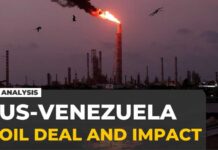

President Trump claimed the United States now holds majority control over 65 billion barrels of Venezuelan oil — but the public record shows no signed transfer proving it.
Story Snapshot
- Trump announced a “no-cost” deal giving the U.S. majority control of 65 billion barrels in Venezuela.
- U.S. officials previously described arrangements over sanctioned oil sales and revenue oversight, not reserve ownership.
- Venezuelan law states oil in the ground belongs to the Republic and is inalienable.
- Critics in the U.S. and Venezuela call the reported move unconstitutional and opaque.
What Trump Announced And Why It Matters
On August 28, President Trump said the United States secured “majority U.S. control” of more than 65 billion barrels of proven Venezuelan oil reserves. He called it the “biggest oil deal in world history” and said it came at no cost to taxpayers. He credited Secretary of State Marco Rubio and Secretary of War Pete Hegseth and said the arrangement involved private business and Venezuela’s interim leadership. The claim implies a dramatic shift in control of Venezuela’s core national resource.
Earlier this year, Secretary of State Marco Rubio described a narrower setup. He told senators the United States would let sanctioned Venezuelan oil move to market at market prices. In return, funds would go into an account under U.S. oversight. That was framed as an arrangement to manage sales revenue from quarantined oil, not a transfer of ownership of reserves in place. This difference matters because “control” can mean very different things in law and energy markets.
What The Law Says About Who Owns The Oil
Venezuelan law is clear on resource ownership. Article 12 of the Constitution says hydrocarbon reservoirs belong to the Republic, are public domain assets, and are inalienable and indefeasible. That means the state cannot sell or transfer the nation’s subsurface oil endowment as property. Any foreign access normally comes through operating rights or joint ventures, not transfer of the reserves themselves. A true shift to “majority U.S. control” of reserves would need explicit, verifiable legal instruments.
Public reporting has not shown a signed transfer document that would override these limits. The August announcement quoted by major outlets did not include such a record. Without a published contract or treaty, the best documented actions involve moving sanctioned oil, handling revenue, and opening parts of the sector to foreign investment, not reserve ownership. This gap between rhetoric and paperwork fuels doubts among analysts across the spectrum about what has actually changed.
Why Critics On Left And Right Are Alarmed
Venezuelan opposition figures and international commentators called the reported U.S. move predatory and unconstitutional. Economist Ricardo Hausmann argued that an interim government lacked legitimacy to strike a deal that hands over national oil wealth. He said such a step would violate Venezuela’s Constitution. In the United States, lawmakers and industry experts warned the transactions looked opaque and lacked strong oversight, raising corruption risks during a high-stakes resource shift.
🚨 Trump’s ‘Biggest Oil Deal In World History’ With Venezuela
The deal could give the U.S. access to vast Venezuelan oil reserves and attract $100 billion in investment.
But can Venezuela ramp up production quickly enough?
Watch: https://t.co/onhEEhqLjE#Trump #Venezuela…
— CNBC-TV18 (@CNBCTV18News) August 29, 2026
Energy analysts add a practical warning. They say reviving Venezuela’s oil fields takes huge money, secure contracts, and time. Some estimates say billions in new spending and up to a decade before major output gains appear. Boardrooms also call the country “uninvestable” unless rules and security improve. That means even a generous access deal would not quickly lower gas prices at home. It would not fix the deeper problems that push costs up for families and small businesses.
What We Know, What We Don’t, And The Stakes For Americans
We know the administration claims sweeping control of reserves. We know officials earlier described a revenue and sanctions framework, not ownership change. We know Venezuelan law guards state ownership of oil in the ground. We do not have a public, signed legal instrument that transfers reserve control to the United States. Until that appears, the safest read is that Washington is steering sales and cash flows from some barrels, not holding title to the resource base.
For many readers, this episode fits a pattern: big promises, thin documents, and decisions made far from public view. Conservatives see risk of mission creep and long, costly foreign entanglements that do not cut prices fast. Liberals see a resource grab that widens the gap and sidelines democratic checks. Both sides see a federal machine that talks big, picks winners, and leaves regular people guessing. Hard proof, clear terms, and real oversight are the only cures for that distrust.
Sources:
bbc.com, factcheck.org, state.gov, nytimes.com, pbs.org
© newsalertdaily.org 2026. All rights reserved.