
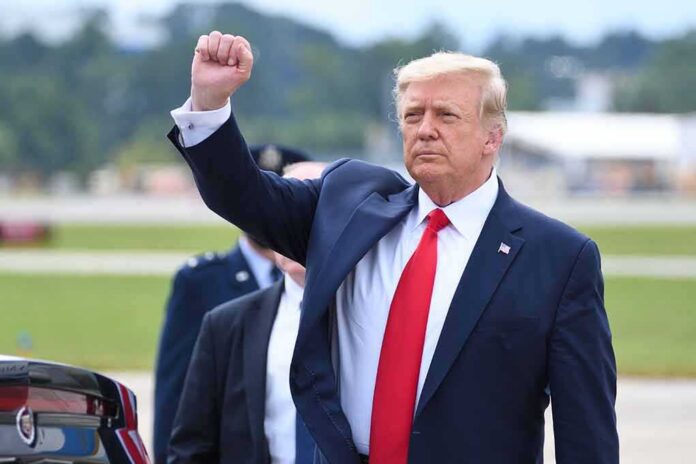
President Trump said he “may” meet North Korea’s Kim Jong Un, reviving high-stakes summit politics that have swung between bold deals and breakdowns.
Story Snapshot
- Trump said a meeting with Kim is possible, citing past rapport.
- Prior diplomacy laid a path for leader-level talks between the two.
- The 2018 Singapore summit produced a denuclearization statement.
- The hint signals another attempt to manage a long-running nuclear standoff.
Trump Signals Openness To Another Kim Jong Un Meeting
President Trump told reporters he “may” meet with North Korean leader Kim Jong Un and called the idea “exciting.” He also said he gets along with Kim, pointing to a personal channel that has existed before. The comment marks a fresh opening for top-level contact after years of fits and starts. The statement describes a possibility, not a plan with dates or a set agenda. The White House has not issued a formal schedule tied to the remark.
Trump and Kim have used direct meetings to create momentum in the past. In March 2018, South Korea’s national security adviser announced that Kim wanted to meet Trump soon, and Trump agreed to pursue talks on denuclearization. That same year, Trump wrote Kim that he looked forward to meeting, even after tensions rose over timing and terms. The approach relied on leader-level engagement to break through long policy deadlocks.
What Past Summits Produced—And What They Did Not
Their first summit in Singapore on June 12, 2018, ended with a joint statement. It pledged new relations, a lasting peace regime, and denuclearization of the Korean Peninsula. The result was big on symbolism and opened space for working talks. It did not include a step-by-step plan, deadlines, or verification terms. Later efforts struggled to settle core trade-offs, like the scope of nuclear rollback and the scale of sanctions relief.
The record shows why a “may meet” signal matters but does not settle outcomes. Leader meetings can pause tensions and unlock talks. They can also stall if teams cannot close gaps on inspections, timelines, and what each side gives first. Analysts at the time warned that summits create expectations that working negotiators must meet with real terms and checks, not only broad goals.
Why This Matters For Americans Watching Washington
Any path that reduces the risk of war on the Korean Peninsula serves U.S. families, troops, and allies. A direct Trump–Kim meeting could slow missile tests, free detainees, or set guardrails while talks continue. That said, the government has often chased headlines over hard details. Many citizens across left and right worry that leaders seek short wins while nuclear risks grow. Clear goals, honest timelines, and measurable steps can counter that fear.
Kim Jong Un Showcases US-Reaching Missile as Trump Hints at Possible North Korea Summit Meeting
Watch: https://t.co/gTQ7jqeqNk pic.twitter.com/7R7tApaRe0— India Today Global (@ITGGlobal) October 14, 2026
This hint comes as the United States still faces a nuclear-armed North Korea and an overstretched global posture. Past cycles show a pattern: confrontation rises, leaders meet, talks stall, then pressure returns. Experts say success depends on verified limits on weapons and a tight process for follow-up. Americans should expect plain updates on what each side agrees to do, by when, and how officials will check it. That is how trust is earned in a weary public.
Key Questions If Talks Move Forward
If planning advances, three questions will shape results. First, what concrete steps will each side take in the first sixty to ninety days? Second, how will inspectors confirm actions on the ground? Third, what relief or security incentives come only after proof of progress? The 2018 experience shows that broad promises are not enough. A durable deal needs clear sequencing, strong verification, and steady alliance coordination with South Korea and Japan.
Sources:
zerohedge.com, pbs.org, democracynow.org, transcripts.cnn.com, npr.org
© newsalertdaily.org 2026. All rights reserved.