

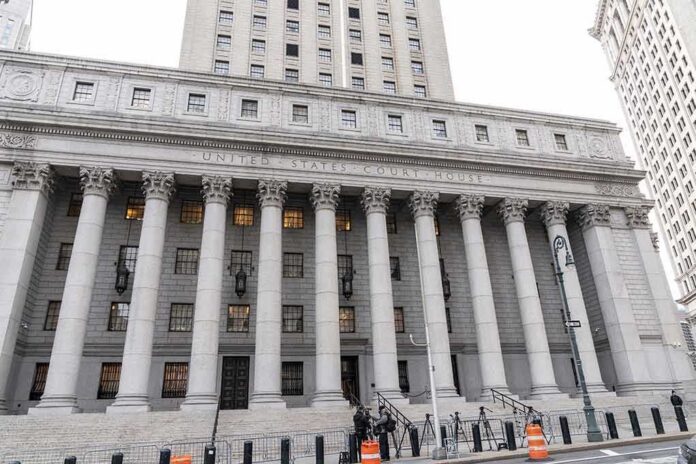
A Washington teen wrestler is asking the Supreme Court to let her compete in girls’ wrestling without facing male athletes under a state policy that she says put her at risk.
Story Snapshot
- A student seeks emergency Supreme Court relief to avoid boys in girls’ wrestling.
- The request follows a 2025 match where she alleges sexual contact by an opponent.
- Washington’s athletics association defends its gender-identity participation policy.
- Recent Supreme Court rulings allowed states to separate sports by biological sex.
What the emergency request asks the Supreme Court to do
Attorneys for Rogers High School student Kallie Keeler filed an emergency application asking the Supreme Court to let her wrestle on the girls’ team without competing against male athletes. They argue that, without relief, she must skip the coming girls’ season or face boys in contact matches. The filing also asks, in the alternative, that schools give parents advance notice before a girl is matched against a male athlete in contact or competitive-skill sports.
The application follows lower court setbacks. Reports say the United States Court of Appeals for the Ninth Circuit denied emergency relief and described a broader notice demand as too sweeping. Keeler’s lawyers frame the issue as a Title IX question: does forcing a girl to choose between safety and participation treat females worse than males in sports? The Supreme Court can grant or deny temporary relief while the case continues in the lower courts.
The December 2025 match and the lawsuit’s core claim
The case turns on a December 6, 2025 tournament match in Washington state. Keeler, then 15, alleges her opponent made sexual contact during the bout. Media reports say she signaled to her mother during the match and mouthed that fingers were in her vagina. Prosecutors later declined to file criminal charges against the transgender opponent. Keeler sued school and state officials, alleging deliberate indifference to a known risk of sexual assault. These remain allegations in a civil case.
The record includes disputes over who knew what, and when. Keeler’s attorneys say the district waited 55 days to inform its Title IX coordinator. The district says the coordinator was not told until January 30, 2026 because no formal Title IX complaint was filed at first. Without the court filings and internal records, the public cannot verify that timeline independently. Federal investigators also reviewed the incident earlier this year, according to reports.
Washington’s policy and what supporters say it aims to protect
The Washington Interscholastic Activities Association states that athletes compete in programs consistent with their gender identity or the gender most consistently expressed. The association says it follows state law, seeks equal opportunities for transgender and gender-diverse students, and aims to create a safe, supportive environment free of discrimination. It also notes it would revise policies if state law changes in the future.
Advocates for inclusion argue that participation should be judged on fairness and access for all youth. The Washington LGBTQ Commission urges that transgender, non-binary, gender-diverse, and intersex athletes be welcomed on teams aligned with their gender identity. They say sports should be a level field for everyone, and they cite the long-standing Washington framework that endorses inclusion in school sports.
Title IX, new Supreme Court rulings, and why this moment matters
Congressional Research Service materials explain that Title IX bans sex discrimination in schools that receive federal funds and that regulations permit separate teams by sex if schools provide equal athletic opportunities. On June 30, 2026, the Supreme Court upheld West Virginia and Idaho laws that separate female sports by biological sex. Those rulings do not end every case, but they clarify that sex-separated teams are lawful under federal law.
Keeler’s lawyers say the new rulings support her right to a girls’ season without male opponents. Washington officials and the athletics association point to their duty to follow state law and protect transgender students from discrimination. The Supreme Court’s response to this emergency request could shape how schools balance safety, fairness, and inclusion in contact sports while the full case proceeds. For many families, it also reflects a deeper worry that systems protect institutions before students.
What remains unclear and what to watch next
Key records are not public. The complaint, the emergency application, and lower court dockets are not included in the available reports. There is no public video, medical record, or official match report in the sources. The civil claims have not been proven or disproven in court, and prosecutors did not file charges. Watch for the Supreme Court’s decision on temporary relief, any release of court filings, and whether Washington revisits its policy after recent rulings.
Sources:
zerohedge.com, washingtonexaminer.com, washingtontimes.com, foxnews.com, kpq.com, applevalleynewsnow.com, lynden.wednet.edu, clarkcountytoday.com, genderdiversity.org, bignewsnetwork.com, lgbtq.wa.gov, congress.gov
© newsalertdaily.org 2026. All rights reserved.