
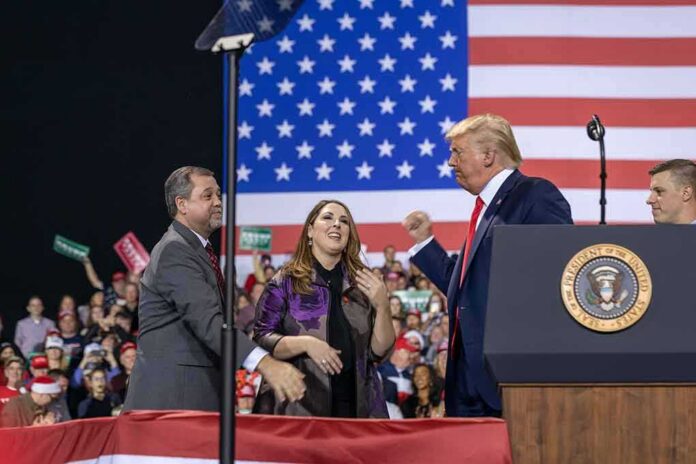
President Trump flew 3,400 miles to Wasilla to boost Sen. Dan Sullivan and tie his bid to a $54 billion gas project pitch.
Story Highlights
- Trump said he traveled to Alaska to help Sullivan and praised him as “very good”.
- A Wasilla rally was scheduled as a campaign event with Sullivan and Nick Begich on stage.
- Trump promoted a proposed $54 billion Alaska liquefied natural gas project investment.
- The Senate race is competitive under Alaska’s ranked-choice system and primary results.
Trump’s Stated Mission: Help Dan Sullivan Win
President Trump said he was going to Alaska to help Senator Dan Sullivan and called him “very good,” framing the trip as a direct campaign push. The Anchorage Daily News listed the Wasilla stop as a rally at the Curtis D. Menard Memorial Sports Center with Sullivan and Representative Nick Begich. The message was clear and personal. Trump’s praise focused on Sullivan’s record and fit a common pattern of presidents stumping for at-risk allies during midterms.
Reporters and outlets framed the journey as unusual due to the long distance and the perceived stakes of the race. Trump’s second-term travel has centered on protecting Senate control. The stop placed national attention on a state that rarely draws late-stage visits from presidents. The campaign set a scene where the candidate, the White House, and state Republicans stood together to rally base voters and reach undecided Alaskans.
A High-Dollar Energy Pitch Takes Center Stage
Trump promoted a proposed $54 billion investment tied to the Alaska liquefied natural gas project during his Alaska stop, highlighting promised jobs, energy supply, and export potential. His remarks credited long-running work on the project by Sullivan. The Alaska liquefied natural gas plan envisions moving North Slope gas to an export terminal, a multibillion-dollar goal debated for years due to cost, markets, and financing needs. Supporters argue it could lower costs and expand U.S. energy reach.
The investment discussion added a concrete policy frame to the rally. It tied Sullivan’s pitch to pocketbook issues like energy prices and jobs, which speak to voters across party lines. The Associated Press reported that South Korean participation had not been finalized and depended on commercial viability reviews. That caveat did not stop the campaign from using the project as a symbol of development, national strength, and supply security in a world hungry for energy.
Why Alaska’s Senate Race Drew a Presidential Stop
Alaska’s system uses ranked-choice voting, which can keep races tight and unpredictable into late counts. The Anchorage Daily News reported that former Representative Mary Peltola outpolled Sullivan in the August open primary, showing a real contest ahead of November. That early marker made the seat look competitive, raising the value of a high-profile visit. The rally sought to mobilize conservatives while appealing to independents focused on the economy and energy.
Political science research finds mixed results from presidential midterm visits, with some studies pointing to turnout gains that may decide close Senate races. Other work shows presidents target competitive ground but do not always change outcomes. The Alaska stop followed that playbook: concentrate attention, raise stakes, and try to shape late media cycles. The goal was simple. Make Sullivan the safe choice for stability, energy growth, and federal backing.
The Cross-Party Stakes on Energy and Governance
Energy costs, job security, and trust in leaders formed the rally’s subtext. Voters on the right want lower prices, stronger borders, and less red tape. Voters on the left want fair growth, cleaner options, and less corporate sway. Both sides share doubts that Washington serves regular people. The Alaska liquefied natural gas push, if real and durable, promises jobs and supply. If it stalls, it risks looking like another big promise from faraway leaders.
TRUMP ON THE CAMPAIGN TRAIL: President Trump throws his support behind Sen. Dan Sullivan, joking he’s backing the real Dan Sullivan and not the one put up by the Democrats.#NYI pic.twitter.com/z66gtovgeg
— NewYork-Insight (@NewYork_Insight) October 14, 2026
The campaign framed the project as proof of action, not talk. Supporters said Sullivan’s years on the issue show persistence. Critics of mega-projects warn about costs and market shifts. The hard test will be financing, buyers, permits, and construction timelines. For now, the headline is the visit itself. A sitting president put time and political capital into one Senate seat, in one small city, because control of Congress can hinge on margins this thin.
Sources:
pbs.org, latimes.com, abcnews.com, abc45.com, adn.com, reuters.com, news.ballotpedia.org
© newsalertdaily.org 2026. All rights reserved.