

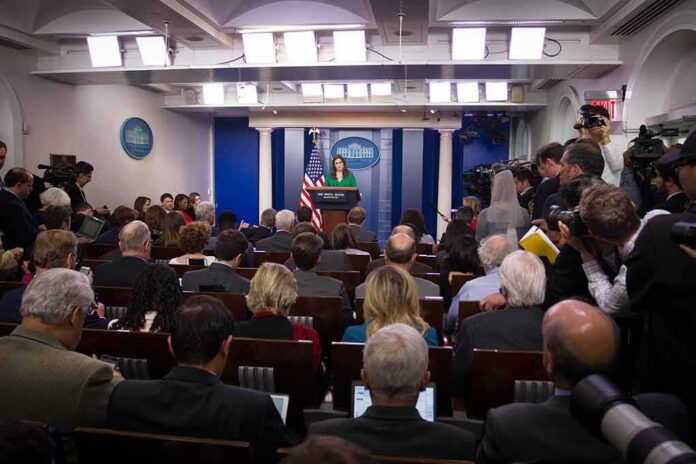
After just five days as White House press secretary, Katie Zacharia is leaving, marking a record-short tenure confirmed by multiple outlets and officials.
Story Snapshot
- President Trump named Zacharia press secretary on October 9 and praised her loyalty.
- The White House said October 16 that Zacharia was transitioning out after a rocky start.
- Trump publicly urged her to reconsider taking the job before the exit was finalized.
- The departure underscores how fast trust and scrutiny can decide top communications roles.
What Happened And When
President Trump announced on October 9 that Katie Zacharia would become White House press secretary, succeeding Karoline Leavitt. He called her a loyal and brilliant supporter. Zacharia posted that the role was the honor of a lifetime and praised Trump’s leadership. By Friday, October 16, the White House said she was transitioning out following a rocky week. Reports described a five-day tenure, from Monday to Friday, that ended with unusual speed for such a high-profile job.
Trump told reporters he had advised Zacharia to reconsider the job and said he would let her decide. Coverage described mixed signals as officials confirmed she was leaving while noting ongoing discussions. Communications director Steven Cheung defended her as uniquely qualified and whip smart amid criticism. Outlets also reported that questions about her claimed legal credentials added pressure. The administration did not issue a detailed, on-the-record personnel memo spelling out the final terms.
How The Exit Fits A Larger Pattern
Zacharia’s five-day stretch is being reported as the shortest service for any White House press secretary. Past short terms still lasted weeks, such as Jerald terHorst’s month in 1974 and Jonathan Daniels’s 48 days in 1945. The average press secretary has served close to three years since the role emerged. The closest modern comparison is Anthony Scaramucci’s 11 days as communications director in 2017, a different post but a similar communications flashpoint.
Trump’s first administration cycled through several communications leaders, and this second-term episode signals how fragile these roles remain. These jobs depend on direct presidential trust, fast command of facts, and message discipline under bright lights. A stumble can snowball within hours as opponents, allies, and media all react at once. That speed turns praise at appointment into pressure by the week’s end when controversy strikes, even for well-known communicators.
Why This Matters To Readers
Rapid turnover at the top of the press office fuels a bipartisan worry: government looks unstable and reactive, not steady and focused on results. People on the right see media storms and elite pile-ons that can kneecap appointees before they settle in. People on the left see a hires-and-fires culture that prizes loyalty over proven skill. Both groups see a system that struggles to communicate clearly about real problems that affect daily life, from costs to safety to trust.
White House has said its press secretary Katie Zacharia is leaving the role after less than a week on the job amid strong media criticism.
Zacharia’s departure was confirmed by US President Donald Trump, who told reporters on Friday that he had told Zacharia to "reconsider" her… pic.twitter.com/vCVgCuobXQ
— GAROWE ONLINE (@GaroweOnline) October 17, 2026
Clear, credible public communication is not a luxury in a divided country; it is the job. When a press secretary changes in days, agencies and citizens lose a key guide to policy and events. That gap lets rumors fill the space where facts should be. The Zacharia episode shows how the nation’s message machine can jam at the worst time. Stable leadership, transparent vetting, and steady standards can help rebuild faith that the government is working for the people.
Sources:
apnews.com, inquirer.com, stlpr.org, bbc.com
© newsalertdaily.org 2026. All rights reserved.