

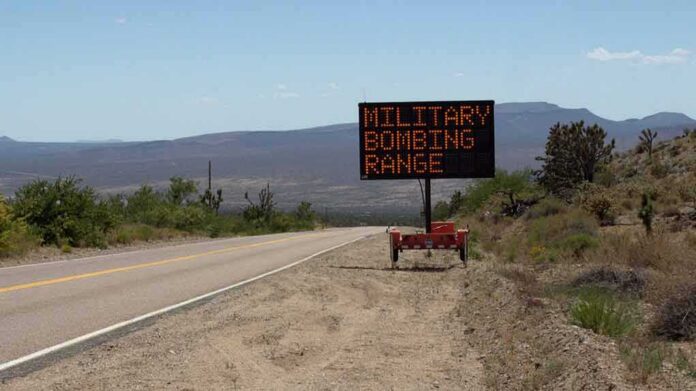
President Trump announced that Montana will host a new Pentagon “super range” to test advanced weapons and technologies.
Story Snapshot
- Trump said Montana will get a Defense Department testing “super range.”
- The range would support autonomous systems, space, electronic warfare, and hypersonic weapons.
- Defense testing capacity is stretched; new range space could ease bottlenecks.
- Formal steps like environmental review and funding typically follow such announcements.
What Trump Announced In Kalispell
President Trump told a crowd in Kalispell on October 14 that Montana will host a new defense “super range” for testing cutting-edge systems. He said the range will support autonomous weapons, space systems, electronic warfare, and hypersonic weapons. The remarks framed the project as part of keeping the United States ahead of rivals in next-generation warfare. Multiple outlets recorded and reported the announcement, which was delivered at a campaign rally in the state.
The White House and supporters highlighted Montana’s vast land and sparse population as natural fits for high-risk testing. The president said the range would help ensure the military “reigns supreme,” tying the idea to broader national security goals. Coverage across television and online outlets echoed the core details from the stage. The announcement did not cite a specific site, timeline, or budget, which often follow later through formal agency actions and congressional steps.
What A “Super Range” Could Do
A large, instrumented test area would give engineers and operators room to push long-range and high-speed systems to their limits. Hypersonic flight tests need wide safety buffers and complex tracking gear. Electronic warfare trials require clean spectrum and separation from civilian signals. Space system tests can need special ground stations and secure corridors. Analysts note that test demand has outpaced capacity in some mission areas, so added range space could reduce delays and rework.
Communities near major ranges often see new jobs in construction, operations, and support services. Research reviews have found that base expansions can bring local gains, though impacts vary by region and industry mix. Local leaders usually focus on roads, housing, schools, and emergency services that growth requires. Regional planners in Montana would likely weigh those basics if the project advances, balancing economic benefits with land use, noise, and safety planning needs around any chosen site.
How A Rally Announcement Becomes Reality
Defense projects move through a set path after a headline moment. The Department of Defense validates needs, compares sites, and starts environmental review under federal law. Congress authorizes and funds construction and operations. Agencies map airspace, spectrum, safety zones, and community buffers before major testing begins. Government Accountability Office reporting shows that range programs face recurring hurdles, including encroachment, data gaps on capacity, and long-term funding strains that leaders must address early.
Trump says the Pentagon will establish a new defense 'super range' in Montana to test advanced weapons tech: autonomous weapons, space systems, electronic warfare and hypersonics. No cost or timeline announced. (via Reuters)
— Bay Street Finance (@BayStreetBulls) October 16, 2026
Past reviews urged the Pentagon to better plan for training and testing limits, map noise and safety, and work with local governments. That history suggests Montana’s proposed range will require tight coordination with counties, tribes, landowners, and regulators. Clear timelines, transparent siting, and steady budgets often decide whether projects start on time. While the rally set the goal, the next public signals will be official filings, budget lines, and agency records that put dates and maps to the plan.
Sources:
zerohedge.com, washingtonexaminer.com, nbcnews.com, gao.justia.com, gao.gov
© newsalertdaily.org 2026. All rights reserved.