
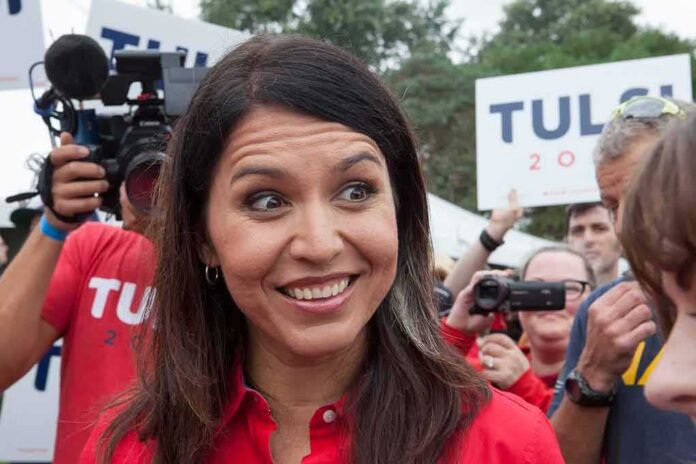
Tulsi Gabbard, once a Democratic rising star from Hawaii, now runs America’s intelligence apparatus under President Trump — a shift confirmed by her 2025 swearing-in.
Story Snapshot
- Gabbard took the oath in 2025 to become Director of National Intelligence, citing duty and impartial intelligence service.
- She left the Democratic Party in 2022, blasting party leaders as an “elitist cabal of warmongers”.
- She served four terms in Congress representing Hawaii’s 2nd District from 2013 to 2021.
- Her rise tracks a larger era of party switching and anti-establishment branding across U.S. politics.
From Hawaii’s 2nd District to a National Security Post
Public records show Tulsi Gabbard served four terms in the United States House of Representatives for Hawaii’s 2nd District from 2013 to 2021. That tenure built her national profile and committee experience. News coverage and official biographies describe that period as the foundation for her later roles. The Office of the Director of National Intelligence highlights this congressional service as central to her qualifications to lead the intelligence community in 2025.
In January 2025, the Office of the Director of National Intelligence announced she took the oath as the eighth Senate-confirmed Director of National Intelligence. The statement noted she is the first female combat veteran to hold the office. It also quoted Gabbard stressing the need for accurate, unbiased, and timely intelligence for the President, Congress, and the military. The release framed her military and congressional background as key to meeting that standard.
Breaking With Democrats and Recasting Her Brand
On October 11, 2022, Gabbard declared she was leaving the Democratic Party. She said party leaders had embraced extreme positions, used identity politics, and pushed policies she saw as dangerous. She described the party as under the control of an “elitist cabal of warmongers” and argued it weaponized national security. Major outlets reported her remarks, which she delivered in a video and podcast statement that day, marking a clean break with her prior affiliation.
The departure capped years of tension with party leadership and moved her closer to voters who distrust Washington’s establishment. Her pivot aligned with a broader trend in modern politics. High-profile defections can boost a politician’s visibility even as they strain ties with former allies. Political research finds party switches can damage a party’s image while giving defectors a sharper identity in a new coalition, especially in polarized times.
Why Her Appointment Resonates Across the Aisle
Gabbard’s confirmation drew attention because it placed a vocal critic of party elites in charge of intelligence coordination. Supporters see a combat veteran who promises unbiased reporting to the White House and Congress. Critics worry about rapid realignment and past sharp rhetoric. The official announcement, however, focused on her duty to deliver objective intelligence to decision-makers, signaling continuity in mission despite political shifts at the top.
March–spring 2019 — Steve Bannon asked Jeffrey Epstein to provide an aircraft to collect him in Rome. Epstein repeatedly offered a private jet or charter flight for Bannon’s European travel, and the released messages indicate that Bannon stayed overnight at Epstein’s Paris…
— Insurrection Barbie (@DefiyantlyFree) September 29, 2026
For many Americans, the arc from Democratic lawmaker to Director of National Intelligence under a Republican president underscores a shared concern: institutions often reward brand power over straight answers on security, spending, and war. Gabbard’s path reflects that tension. She turned public doubts about elite decision-making into a platform that now carries real responsibility. The measure of this chapter will be whether her office delivers facts, not spin, when the stakes are highest.
Sources:
youtube.com, odni.gov, goodmorningamerica.com, ny1.com
© newsalertdaily.org 2026. All rights reserved.