
At Mount Rushmore, President Trump used a July 4th “Salute to America 250” speech to praise America’s founding while branding his opponents as communists and touting big economic wins that critics say lack proof, sharpening fears on both left and right that patriotic celebration is being mixed with polarizing spin.
Story Snapshot
- Trump’s “Salute to America 250” speech tied America’s 250th birthday to a sweeping defense of his agenda and attacks on “communists.”
- He cast Democrats and “woke” culture as a communist threat, echoing a broader pattern in his second term.
- He claimed massive investments and policy victories without offering clear evidence, raising questions about accuracy.
- Critics point to money, media, and business interests around America 250 events as signs of an elite-driven spectacle.
Trump’s July 4th message: praise for America, warning about “communists”
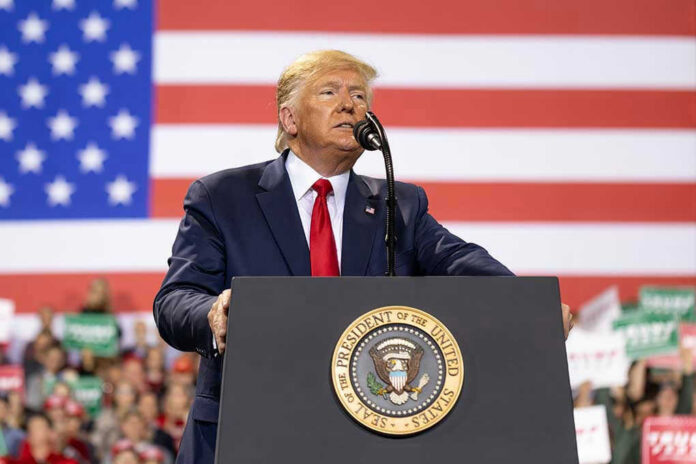
During his Mount Rushmore remarks tied to “Salute to America 250,” President Trump described the United States as “the most magnificent country in the history of the world” and “the oldest republic on Earth,” tying today’s politics directly back to the courage of the Founders. He framed the 250th anniversary as proof that America’s system still works, even as many citizens feel locked out of the American Dream and angry at both parties for serving insiders instead of regular people.
Trump’s speech went beyond patriotic praise and turned hard toward warning language about enemies at home. He said Americans face “a resurgence of the communist menace,” calling communism “the greatest threat to our country including World War I, World War II, Pearl Harbor, or even 9/11.” He told listeners, “You can be loyal to Karl Marx, or you can be loyal to America. You can be a communist, or you can be a patriot. You cannot be both.” That line aimed straight at Democrats and activists he sees as part of a “woke” left.
Labeling Democrats “communists” fits a broader pattern of enemy politics
Trump’s Mount Rushmore attack on “communists” lines up with how he has used that label across his second term. Reporting from the Los Angeles Times notes that Trump now calls judges, educators, and other critics “communists,” and his aides describe “cancerous, communist woke culture” that he says is “destroying this country.” Experts quoted by PBS explain that branding Democrats as Marxists or communists, without direct evidence from their policies, pulls from Cold War-style fear tactics and deepens polarization instead of solving real problems.
Political scholars describe this style as a “politics of enemies,” where opponents are cast not as people to argue with but as threats to be beaten or removed. Linguists studying Trump’s rhetoric say such words are chosen to stir fear and anger, especially among people who already feel that elites look down on them. For conservatives tired of “woke agendas” and liberals angry over “America First” policies, this language can sound like someone finally naming their frustrations—yet it also makes compromise and practical problem-solving even harder.
Big economic claims, thin on proof, in a time of deep distrust
Alongside his warnings about communism, Trump highlighted what he called record economic success, claiming “$19.2 trillion in investments pouring into the U.S. as of last week,” compared with “much less than one” trillion under the previous administration. He also said he lifted 2.4 million Americans off food stamps and that “plants and factories are being built all over the United States right now.” These numbers speak to hopes on both sides for stable jobs, lower prices, and a fair shot at the American Dream.
The problem is that the speech transcript does not cite Treasury reports, Agriculture data, or independent audits to back those specific figures. There is no source given for the $19.2 trillion number, no official count attached to the food stamp claim, and no detailed list of new factories. Critics say this turns major national concerns—like inflation, energy costs, and inequality—into talking points rather than measurable progress. For Americans who already believe the government hides the truth, unsupported claims from any leader, left or right, only deepen suspicion that numbers are being used to score points, not to guide policy.
Patriotism, money, and the worry that America 250 is an elite show
Trump has pushed “Salute to America 250” and related efforts like Freedom 250 as a year-long, “spectacular” celebration to honor the nation’s founding and showcase America “at its best.” Plans include a huge state fair on the National Mall, major fireworks, sports events, and religious-themed ceremonies meant to highlight the country’s spiritual roots. On paper, these events promise community pride and shared history at a time when the country badly needs common ground.
Fireworks and Trump Speech Cap Independence Day Celebrations.
(TRUMP PROMISED HIS JULY 4TH SPEECH WOULD BE “REALLY LONG”- 35 MINUTES?!😂)
…Mr. Trump’s 35-minute address was followed by what the White House had billed as “the largest pyrotechnics…
https://t.co/YhBU9XtiDs— CLH (@CLH111354) July 5, 2026
Yet reporting about previous July 4th celebrations and the companies behind them has raised questions about who truly benefits. A New York Times piece cited in multiple reports says a firm with deep ties to Trump allies helped organize major events and that taxpayers faced costs estimated around tens of millions of dollars, with profit details opaque. Opinion videos and social media posts argue that the mix of large public funding, political branding, and private business gains looks less like a unifying national birthday and more like an elite-run spectacle built on ordinary citizens’ money and fears.
Why this speech matters for frustrated Americans on both sides
For many conservatives, Trump’s Mount Rushmore message speaks directly to anger over globalism, illegal immigration, rising prices, and a sense that traditional values are under attack. For many liberals, his attacks on “communists” and vows to crush opponents echo their fears that dissent, minority rights, and social programs are being targeted. In both cases, people see a federal system that feels more focused on winning power than on fixing schools, health care, housing, and wages.
Trump’s “Salute to America 250” speech captures that tension perfectly: it celebrates real American courage and freedom, but it also turns a national milestone into another battlefield between “patriots” and “communists.” The fact that so many key claims in the speech—about investments, victories over foreign foes, and economic gains—are not backed by shared, public data shows why trust is so fragile. When leaders on any side wrap unverified numbers in patriotic language, they tap into honest pride while feeding the sense that the deep state and the political class are still playing games with the future of the country.
Sources:
nypost.com, rev.com, facebook.com, instagram.com, democrats.senate.gov, youtube.com, apnews.com, pbs.org, en.wikipedia.org
© newsalertdaily.org 2026. All rights reserved.