
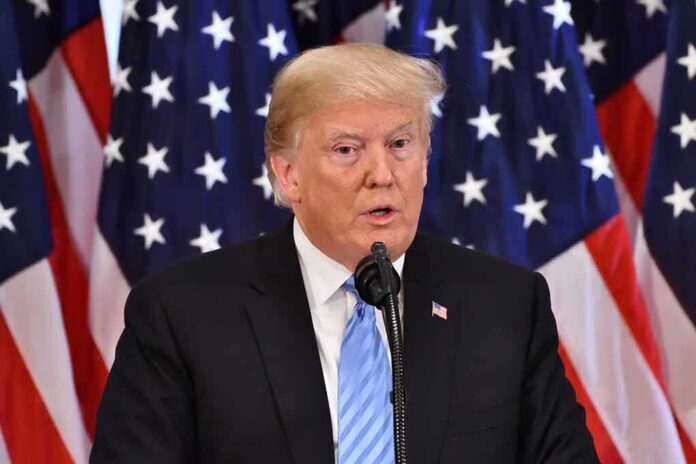
In a single Oval Office appearance, President Trump mixed big policy moves with bold claims that highlight both the power and the growing distrust of the modern presidency.
Story Snapshot
- Trump announced reopening vast Pacific fishing grounds and a major customs enforcement order, promising big savings and lower food prices.
- He paired these policy claims with dramatic stories about reflecting pool vandalism and fast restoration costs that so far lack hard public proof.
- Mainstream outlets and fact-checkers question several of his damage and arrest claims, while Trump urges supporters to dismiss them as “fake news.”
- The clash between partisan coverage and skeptical reporting deepens a media trust crisis that many Americans on both left and right already feel.
Trump’s Oval Office agenda: fishing, fentanyl, and federal savings
President Trump used a June 2024 Oval Office address to announce the reopening of nearly 500,000 square miles of United States waters in the western Pacific for commercial fishing, describing it as a way to reclaim maritime heritage and cut seafood prices for American families. He praised American fishing communities and said expanded access would mean “millions, tens of millions of dollars” in income for fishermen and coastal towns. Trump also credited specific officials for driving the fishing policy, including Secretary of Commerce Howard Lutnik, Secretary of the Interior Doug Bergam, Alaska Governor Mike Dunlevy, and Congresswoman Kimberly King Hines.
Alongside the fishing move, Trump announced a new executive order on customs enforcement that he claimed would save $15 billion in its first year and up to $25 billion in later years, mainly by tightening rules and speeding enforcement of existing laws. He linked these savings to his broader promise to run government “like a business” and reduce waste that both conservatives and liberals often complain about. In the same set of remarks he said fentanyl imports were down 59 percent, praising Customs and Border Protection technology and inspections for cutting drugs coming into the country by land and sea.
Reflecting pool vandalism: dramatic claims, thin evidence so far
Trump’s address moved from policy to symbolism when he described alleged vandalism of the Washington reflecting pool as part of a wider attack on American history and respect for public spaces. He said five people had been arrested and five more were under investigation, but he did not release photos, arrest records, or court filings, promising the public would “see it in court” instead. He claimed a “290 to 350 foot slit” had been cut through the pool with a box cutter and that fertilizer had been poured in to trigger algae growth, forcing an urgent two-month restoration.
Reporters from major outlets who inspected the site during this period reported no visible evidence matching that description, and fact-checkers labeled the slit and fertilizer claims unsubstantiated pending proof from park authorities or courts. Trump further asserted that his team had repaired the pool for $10 to $16.5 million over two months, compared with $147 million over two years under Obama and Biden, but he did not cite project budgets or independent audits to verify either figure. For many Americans who feel Washington wastes money while everyday costs stay high, these sharp numbers sound appealing, yet without documents they remain contested talking points rather than settled fact.
Iran deal talk, partisan media, and a deepening trust gap
Trump also revisited the Iran nuclear issue, calling the Obama-era deal a “path to a nuclear weapon” and claiming Iran had now agreed not to develop nuclear arms, with a new deal possibly signed “very soon, maybe over the weekend.” He acknowledged negotiations were ongoing, but there was no published agreement text or joint statement from United States or Iranian officials to confirm the details at that time. This mix of strong language and incomplete documentation fits a wider pattern where big foreign policy claims reach voters first through television and social media, long before official records catch up.
One America News Network, which carried Trump’s remarks live, is widely seen as a pro-Trump outlet, while networks like ABC, CBS, and CNN approach his claims with more skepticism and regular fact-checking. Research on partisan media finds that both left-leaning and right-leaning channels highlight stories that fit their side and frame events to support favored leaders, often leaving viewers inside “echo chambers” that reinforce what they already believe. Studies also show that switching channels for even a few weeks can change how people view a president’s honesty, policy success, and even basic facts, which helps explain why Trump’s supporters and critics often feel they live in different realities.
Shared frustration: big promises, missing proof, and a government many see as broken
For many older conservatives, Trump’s talk of reopening fishing grounds, cutting drug flows, and saving billions on customs fits long-held hopes for an “America First” government that protects jobs and respects traditional industries. For many older liberals, his harsh language on Iran, immigration, and federal discipline feeds worries about abuse of power, weaker social protections, and discrimination. Yet both groups share a deeper frustration: they often feel the federal government serves elites, lobbyists, and media interests more than citizens working hard to reach the American Dream.
When a president makes detailed claims about arrests, damage, or huge savings without quickly backing them up with records that anyone can check, it reinforces the sense that the truth is trapped inside a distant “deep state” that ordinary people cannot see or trust. Academic work on media bias and polarization warns that this cycle—partisan outlets amplifying leaders, mainstream outlets critiquing them, and citizens doubting everyone—poses a real threat to faith in democratic institutions. The open question from Trump’s Oval Office remarks is not only whether every claim proves true, but whether leaders and agencies will release enough hard evidence to earn back the trust that both left and right increasingly believe has been lost.
Sources:
youtube.com, oann.com, facebook.com, claravdw.com, pmc.ncbi.nlm.nih.gov, polisci.ucsd.edu, 5harad.com, vcresearch.berkeley.edu, pnas.org
© newsalertdaily.org 2026. All rights reserved.