

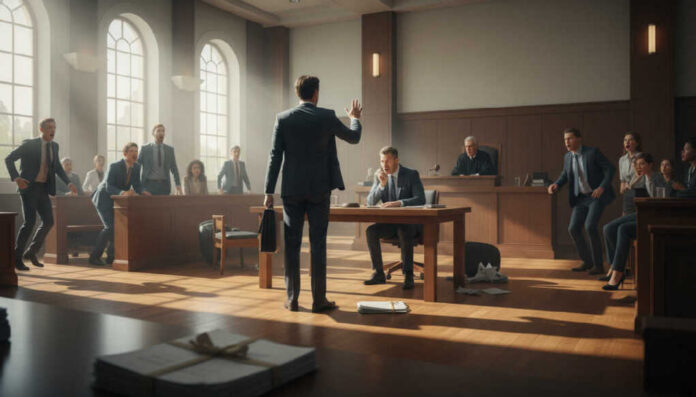
A powerful new court ruling in New Jersey just drew a hard line against secret face-scanning tools quietly deciding who goes to prison.
Story Snapshot
- New Jersey’s Supreme Court now forces prosecutors to reveal when and how facial recognition is used in a case[1][2].
- Defendants must be told which tool was used, who made it, and key error information so they can fight bad IDs[4].
- The ruling is a win for due process, but it still shields corporate source code unless defendants show special need[1][2].
- Growing use of flawed facial recognition raises deep concerns about wrongful arrests, privacy, and government overreach[4][19].
New Jersey Court Pushes Back on Secret Tech in Criminal Cases
New Jersey’s Supreme Court has ruled that criminal defendants must be told when police use facial recognition technology and how it was used in the investigation[1][2]. The case, State v. Tybear Miles, involves a Jersey City murder where police turned to face-scanning software to identify the suspect[4][6]. Justice Douglas Fasciale wrote that the state must disclose “discovery identifying the facial recognition tools and materials” used, including the name and maker of the software and available error data[4]. The ruling applies even when prosecutors do not plan to show facial recognition evidence at trial[1][2]. This means basic details about digital identification tools can no longer stay hidden in New Jersey’s criminal courts.
The decision builds on a 2023 appellate ruling in State v. Arteaga, which had ordered broad disclosure of thirteen categories of facial recognition material[1][5]. In Miles, the high court rejected what it called a “mechanical application” of that earlier checklist and instead said discovery must be weighed case by case[1][2][6]. Still, the justices stressed that defendants generally must receive basic information about the systems used against them, and that such details will often be the “minimum necessary” to protect the right to a fair trial[3][6]. Civil liberties groups, including the American Civil Liberties Union of New Jersey, praised the outcome as a major transparency win and one of the first state high court rulings of its kind[4][10]. For ordinary citizens, this marks an important step away from opaque algorithmic decisions and toward open judicial review.
What Defendants Can See – and What Still Stays Hidden
Under the new standard, prosecutors must turn over straightforward items that show how facial recognition shaped the case against a defendant[4][6]. That includes the original “probe photograph” police fed into the system, any edited versions of that image, and photos the software flagged as matches[4][6]. Defendants also get basic performance data, like publicly available error rates, which can support challenges to the technology’s reliability[4]. These records help defense teams test whether police leaned too heavily on a shaky digital match instead of building solid, independent evidence. For conservatives worried about fair trials and government abuse of new tools, this kind of documentation is critical for real accountability in courtrooms.
The justices, however, stopped short of ordering automatic disclosure of deep proprietary information such as the software’s source code and inner algorithm[1][2][4]. They said defendants must first show a “particularized need” before courts should consider forcing companies to reveal trade-secret material[1][2]. In Miles’s case, the record was not fully developed enough for the court to decide whether that level of access was required[1][4]. This compromise protects corporate intellectual property but leaves a serious gap. Without full access, it can be very hard to expose hidden bias or serious flaws baked into the code. For many defendants, especially those without strong expert support, meeting the court’s special-need test may be difficult in practice[3][17].
Facial Recognition, Wrongful Arrests, and Constitutional Concerns
Facial recognition is now used by police across the country, even though its accuracy has been questioned and wrongful arrests have already been blamed on bad matches[4][19]. Studies and civil rights reports warn that error rates are often higher for people of color, raising serious equal protection and fairness worries[16][19]. A federal civil rights report from 2024 noted that there are no clear federal laws regulating facial recognition use by national agencies, despite major privacy and surveillance risks[19]. The New Jersey ruling responds to this growing concern by tying facial recognition use directly to constitutional fair-trial protections and to the duty to share evidence that may help the accused[4][5]. For citizens who value the Bill of Rights, this is a reminder that technology must answer to the Constitution, not the other way around.
A New Jersey Supreme Court ruling requires transparency about how facial recognition technology is used during investigations. https://t.co/szafBexqow
— reason (@reason) June 26, 2026
Civil liberties advocates argue that “black box” tools have no place in a system that can take away someone’s freedom[7][17]. Defense briefs in the Miles case highlighted longstanding worries about racial bias, low accuracy in real policing, and a pattern of wrongful arrests created by blind trust in algorithmic matches[3][17]. They also pointed back to earlier fights over DNA software, where courts slowly began requiring disclosure of validation studies and error rates so juries could see the full picture[3][17]. New Jersey’s new facial recognition ruling fits this wider push: if a machine helps identify a suspect, the defense must be able to question how that machine works and how often it fails. That core idea protects not only individual defendants, but also public trust in the justice system.
Sources:
[1] Web – New Jersey Supreme Court Requires Transparency for Facial Recognition …
[2] Web – New Jersey Supreme Court orders disclosure of police facial …
[3] Web – [PDF] Supreme Court of New Jersey
[4] Web – State v. Tybear Miles – NACDL
[5] Web – VICTORY! In a major win for civil liberties, the New Jersey Supreme …
[6] Web – New Jersey Court Rules State Must Disclose Facial Recognition …
[10] Web – New Jersey Supreme Court Requires Transparency for Facial Recognition …
[16] Web – The Brave New World of Facial Recognition Through a Criminal Law …
[17] Web – [PDF] The Danger of Admitting Facial Recognition Technology Results in …
[19] Web – [PDF] Challenging Facial Recognition Software in Criminal Court | …
© newsalertdaily.org 2026. All rights reserved.