

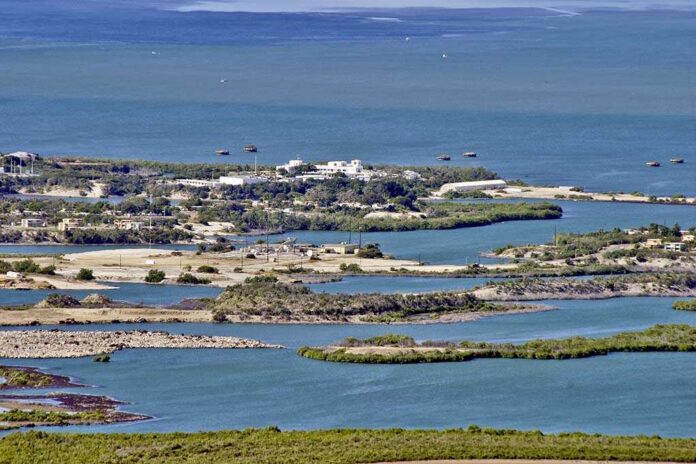
One short-lived object at Scarborough Shoal is now pulling the United States, the Philippines, and China back into a familiar South China Sea trap.
Quick Take
- Reuters reported that satellite images showed a suspected structure near Scarborough Shoal on several days in late May, then it vanished by June 1.[1]
- Philippine officials opened an investigation, but they said they had not yet confirmed what the object was.[4]
- SeaLight said the feature looked persistent, while other reporting still described it as a suspected buoy, barrier, raft, or platform.[1][5][6]
- The episode fits a wider pattern of routine tension, where ambiguous maritime moves become evidence battles before they become facts.[2][3]
What the satellite images show
Reuters said images from May 27 through May 30 showed a suspected floating platform, buoy, or barrier at the entrance to Scarborough Shoal.[1] A June 1 image from Vantor no longer showed it.[1] That simple before-and-after sequence is why the story has spread fast. It suggests a real object may have been present, but it also shows how quickly the evidence changed.
SeaLight said the object was “a persistent feature,” not a brief optical effect.[1] That matters because commercial satellite images can be hard to read from one frame alone. Still, the reporting does not prove the object was a fixed Chinese installation.[1][4][5] The sources repeatedly use cautious language such as “suspected structure,” which is a clear sign that the identity of the object remains unconfirmed.[1][4][5][6]
Why Manila and Washington are watching closely
Philippine defense secretary Gilberto Teodoro Jr. said officials had received raw information, but had not confirmed what the object was.[4] Philippine officials then assigned the National Security Council to investigate.[4] That response shows why the issue matters beyond one shoal. Any new barrier or platform near Scarborough could affect fishing access, patrol routes, and day-to-day control in waters both sides already treat as strategically important.[2][4]
The timing also sharpened the reaction. Reuters said a five-day United States-Philippines maritime exercise in nearby waters ended shortly before the latest patrol reports.[2] That made the area feel even hotter, not calmer. It also explains why the United States is monitoring Chinese activity there. U.S. officials have previously said they were watching for survey activity that could be a sign of future reclamation.[1][3]
The bigger pattern at Scarborough Shoal
Scarborough Shoal has been under de facto Chinese control since the 2012 standoff, and China Coast Guard presence there is now routine.[2] Reuters and other reporting say China has also used barriers, patrols, and blocking moves in the area before.[1] That history does not prove the late-May object was part of a new military plan. It does show why many observers see it as another move in a long gray-zone campaign.
🚨AFP CONFIRMS GROWING CHINESE PRESENCE INSIDE BAJO DE MASINLOC | A floating platform with six individuals onboard remains inside the lagoon of Bajo de Masinloc (Scarborough Shoal).
But the bigger question is:
Why is a single platform being watched over by a growing ring of… pic.twitter.com/XQKDE8zyxC— BRP Sierra Madre (@BRPSierraMadre) June 9, 2026
Legal ambiguity makes the dispute even harder to read. Reuters noted that the 2016 arbitration ruling supported Manila in the wider South China Sea fight, but did not rule on sovereignty over Scarborough Shoal itself.[1] That gap leaves both sides room to claim legitimacy. It also gives Beijing space to dismiss new reports as speculation, especially when the object disappears in later imagery and no official explanation follows.[1][4][5]
Why the story could still matter later
The immediate facts are narrow: a suspicious object appeared, analysts debated it, officials opened a probe, and later imagery did not show it.[1][4][5] But narrow facts can still point to a wider danger. SeaLight, Reuters, and regional analysts all place the event inside a cycle of confrontation that already includes patrol pressure, fishing disputes, and the risk of accidental escalation.[1][2]
That is why this episode will not be judged only by what the first images showed. It will be judged by what follows next. If more imagery, vessel tracking, or official records show a repeat pattern, the object could fit a larger effort to control access at the shoal. If not, it may end as another reminder of how fast unclear maritime scenes can trigger political alarm.[1][4][5]
Sources:
[1] Web – U.S. monitoring Chinese activity in South China Sea around disputed …
[2] Web – Satellite images show suspected structure at disputed South China Sea …
[3] Web – Exclusive-Satellite images show suspected structure at disputed South …
[4] Web – Satellite images show suspected structure at disputed atoll
[5] Web – Philippines Probes May 28 Scarborough Shoal Satellite Imagery
[6] Web – Exclusive-Satellite Images Show Suspected Structure at Disputed South …
© newsalertdaily.org 2026. All rights reserved.