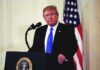

The Supreme Court’s Trump v. Slaughter ruling quietly turned almost every “independent” watchdog in Washington into a direct arm of the president, putting more power in the hands of whoever sits in the Oval Office and less in the hands of the people those agencies are supposed to protect.
Story Snapshot
- The Court ruled 6-3 that presidents can fire most independent agency heads at will, including Federal Trade Commission commissioners.
- The decision overturned the 1935 Humphrey’s Executor precedent that had protected independent regulators from political firing.
- A companion case kept special removal protections for Federal Reserve leaders, creating an exception for the nation’s central bank.
- Supporters call this a win for accountability; critics on left and right fear more politicized regulation and a stronger “deep state.”
What Trump v. Slaughter Actually Did
On June 29, 2026, the Supreme Court decided Trump v. Slaughter, a case about President Trump’s firing of Federal Trade Commission Commissioner Rebecca Slaughter. In a 6-3 ruling, the Court said the president may remove commissioners of the Federal Trade Commission and similar agencies “for any reason,” not just for misconduct or neglect of duty. The majority found that the Federal Trade Commission’s “for cause” removal rule violated the separation of powers in the Constitution by tying the president’s hands. Chief Justice John Roberts wrote that officers who exercise executive power must stay accountable to the president, and that means they must be removable at will.
The decision did more than settle one firing dispute. The Court expressly overruled Humphrey’s Executor v. United States, a 1935 case that had allowed Congress to shield Federal Trade Commission commissioners from political dismissal. Legal analysts explain that, by striking down that precedent, the Court ended the basic model of “independent agencies” whose leaders could ignore presidential direction and keep their jobs anyway. In plain terms, most agency heads who carry out executive-branch laws now serve at the pleasure of the president, no matter which party controls the White House. That includes many regulators who oversee competition, labor, consumer protection, and more.
Why Humphrey’s Executor Mattered and Why Its End Is Huge
For nearly ninety years, Humphrey’s Executor was the legal backbone that kept certain regulators at arm’s length from the White House. Back then, the Court upheld a law saying Federal Trade Commission commissioners could only be removed for “inefficiency, neglect of duty, or malfeasance in office,” not simply for policy disagreements. That rule gave agencies like the Federal Trade Commission, the National Labor Relations Board, and others more freedom to act as neutral referees on business, labor, and consumer disputes. Critics complained those agencies grew into an unaccountable “administrative state,” while defenders said they protected workers and consumers from short-term politics.
Trump v. Slaughter flips that balance. Commentators note that the Court embraced a “unitary executive” view, which says the president must control anyone who enforces federal law. With Humphrey’s Executor gone, Congress can no longer promise multi-member commissions true independence from the president when those bodies exercise executive power. Law firm summaries warn that statutes limiting removal at agencies such as the Consumer Product Safety Commission, the Federal Energy Regulatory Commission, and similar bodies are now on shaky ground. In practice, this means each new president can replace agency leaders quickly and steer enforcement priorities hard in a new direction.
The Federal Reserve Exception and What It Reveals
On the same day, the Court decided Trump v. Cook, a case about a member of the Federal Reserve Board of Governors. There, the Court refused to let President Trump fire a Federal Reserve governor without meeting the law’s “for cause” standard and held that those protections remain constitutional. Analysts point out that this creates a carve-out: the Federal Reserve, which manages interest rates and the money supply, keeps special removal rules while other powerful agencies lose them. That split raises hard questions about why Wall Street’s key regulator stays insulated while bodies that police corporations, workplaces, and products do not.
Critics from different political camps say this exception makes the new doctrine look selective and confusing rather than principled. Some fear it reflects deference to financial elites who depend on a stable central bank, even as other regulators become more exposed to partisan swings. Supporters answer that the Federal Reserve plays a unique role and that markets need long-term stability. Either way, the message to most agencies is clear: independence is out, presidential control is in, and only a narrow club keeps its old protections.
What This Shift Means for Ordinary Americans
Legal and policy commentators warn that agency agendas may now swing more wildly with each election. A president who favors big business could quickly pack commissions with allies who relax enforcement on monopolies, worker safety, or environmental rules. A later president might flip those priorities just as fast, making long-term planning hard for workers, families, and small firms who do not have lobbyists to guide them. That kind of rapid change feeds the common belief that Washington serves political insiders first and ordinary people last, no matter which party is in charge.
The NLRB is hiring a Paralegal Specialist (Summary and Consent) to work in the Division of Enforcement Litigation, Appellate and Supreme Court Litigation Branch. The position is in Washington D.C.
— NLRB (@NLRB_Board) July 17, 2026
At the same time, supporters of the ruling argue that voters at least know whom to blame. Acting Consumer Product Safety Commission Chairman Peter A. Feldman praised the decision, saying it “restored a fundamental principle” that executive officers must answer to the president. For citizens tired of faceless agencies dodging responsibility, tighter White House control can look like overdue accountability. Yet for many Americans on both the right and the left, Trump v. Slaughter reinforces a deeper worry: power is concentrating at the top, and the real struggle is no longer between parties, but between an ever-stronger federal government and a public that feels shut out of decisions that shape their daily lives.
Sources:
reason.com, theguardian.com, theconversation.com, hklaw.com, en.wikipedia.org, jdsupra.com, morganlewis.com, facebook.com, theusconstitution.org, scotusblog.com, law.cornell.edu, ca5.uscourts.gov, youtube.com, dentons.com, law.georgetown.edu, hls.harvard.edu, harvardlawreview.org, academic.oup.com, epi.org, columbialawreview.org
© newsalertdaily.org 2026. All rights reserved.