
When more than a million people pour into the streets of a European capital to hear a pope talk about faith, poverty, and power, it raises hard questions about who is really speaking for ordinary people—and who is just managing the crowd.
Story Snapshot
- Reports say about 1.2 million people filled central Madrid for Pope Leo XIV’s Corpus Christi Mass and procession.
- Local authorities are cited as the source of the estimate, but no public crowd-counting methodology has been released.
- The event mixed deep religious devotion with sharp warnings about poverty and spiritual emptiness in wealthy societies.
- The massive turnout highlights both a hunger for meaning and ongoing distrust of “official numbers” pushed by media and institutions.
A Record Crowd in the Heart of Madrid
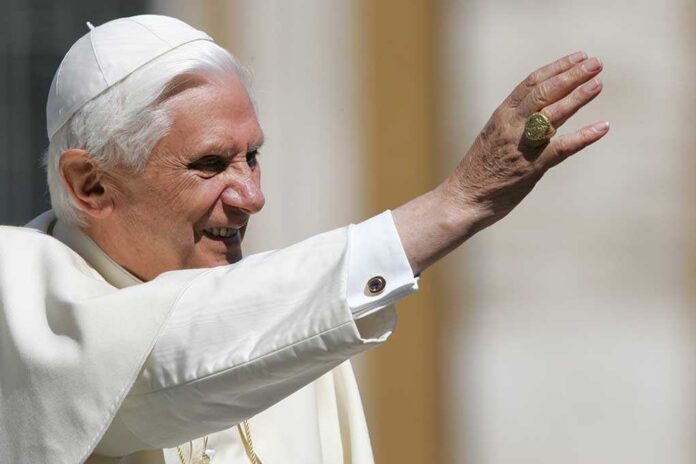
On June 7, 2026, Pope Leo XIV celebrated a large open-air Mass for the Catholic feast of Corpus Christi at Plaza de Cibeles, followed by a Eucharistic procession through central Madrid’s streets.[1] Multiple Catholic outlets report that more than 1.2 million people attended, describing the city center as “filled” or “packed” with faithful lining the route.[1] A short television-style video report attributes the 1.2 million figure directly to local authorities, framing it as an official crowd estimate.[2]
Spanish tourism and city information material had already promoted the papal visit as a major national event, emphasizing that the main celebration would occur in central Madrid between June 6 and June 9.[1] Video clips shared on social platforms show dense crowds around Cibeles Square and along nearby avenues, with people chanting, praying, and filming the pope from phones as he passes in the popemobile. The images support the presence of a very large gathering, though they do not by themselves confirm a precise headcount.
Where the 1.2 Million Number Comes From—and What We Do Not Know
The estimate of approximately 1.2 million people appears consistently in multiple Catholic news reports that covered the Mass and procession.[1] One report states that “more than 1.2 million people filled the streets of Madrid,” presenting the figure as a settled fact tied to the citywide celebration. A widely shared short video says “local authorities have estimated 1.2 million people packed into Madrid’s city center,” suggesting the number originated from police, civil protection, or city officials.[2] However, none of these sources publishes the underlying counting method.
The available coverage does not identify which specific agency produced the estimate, what time window was measured, or how analysts converted aerial images and route maps into a final number.[1][2] There is also no visible breakdown separating those who attended the Mass itself from those who joined only parts of the procession or watched from surrounding streets. This lack of transparent methodology is common in large event reporting, but it leaves room for skepticism from people on both the left and the right who already distrust headline numbers pushed by media and political institutions.[1][2]
Crowd Numbers, Media Narratives, and Public Distrust
Large religious and political gatherings routinely generate big, round attendance figures that are quickly repeated across outlets and social networks, often without any public technical documentation.[1][2] For this Madrid event, the 1.2 million number now appears in print, television scripts, and social posts as a kind of shorthand for “enormous turnout,” even though independent crowd scientists have not yet published any alternative estimates.[1][2] That pattern fits a broader problem many Americans recognize: institutions ask people to trust their numbers while declining to show their work.
Pope Leo tells 1.2 million crowd in Madrid that God stands with the poor https://t.co/3gyXop62s7
— Easmanie Michel (@femmecinephile) June 8, 2026
For citizens who already suspect that elites in government, media, and even religious hierarchies manage perception more carefully than they manage truth, this kind of opaque counting can reinforce doubts. Some will see the 1.2 million figure as proof of authentic grassroots energy anchored in faith and tradition. Others will wonder whether dramatic numbers are being used to bolster institutional authority or push cultural narratives. Both reactions reflect a deeper frustration that hard data about major events is often treated as a public-relations tool rather than a neutral public record.
Faith, Poverty, and the Search for Meaning Beyond Politics
Homilies and summaries of Pope Leo XIV’s message in Madrid emphasize themes that cut across many partisan divides.[1] Reports say he urged Spaniards and Europeans to renew their Christian roots, stand with the poor, and resist a “culture of indifference” that leaves people spiritually empty even as economies grow. Those themes resonate in a world where many feel squeezed between rising costs of living and stagnant wages, and where both conservative and liberal voters suspect that political elites are more interested in power than in justice.
When over a million people gather for a religious event in a modern, secular-leaning European capital, it signals that institutions in Washington, Brussels, and other power centers are not the only forces shaping people’s hopes and fears.[1] The Madrid crowd is a reminder that many ordinary citizens—whether in Spain or the United States—still look for answers in places far removed from political slogans, campaign ads, and bureaucratic talking points. That reality can challenge both nationalist and globalist projects that treat human beings mainly as voters, workers, or data points instead of as persons searching for truth.
Why This Matters to Americans Watching from Afar
For Americans worn out by partisan warfare, ballooning federal debt, and a sense that the “deep state” protects insiders while Main Street struggles, scenes from Madrid carry a mixed message. On one hand, the crowds show how many people still yearn for shared moral language about right, wrong, duty, and care for the vulnerable. On the other hand, the quick promotion of a precise yet undocumented crowd figure looks familiar to anyone skeptical of official statistics closer to home.
Whether the exact attendance was 1.2 million or somewhat higher or lower, the event highlights a broader question: who controls the story when massive numbers of people gather in public spaces, and whose interests do those stories serve?[1][2] As Americans evaluate their own leaders—religious and secular—they may increasingly demand not just inspiring images and booming numbers but also honest methods, open data, and institutions willing to be held accountable by the people they claim to represent.
Sources:
[1] Web – More than a million people packed the streets of Madrid to catch a …
[2] Web – Pope Leo’s Corpus Christi Mass and procession in Madrid draws 1.2 …
© newsalertdaily.org 2026. All rights reserved.