

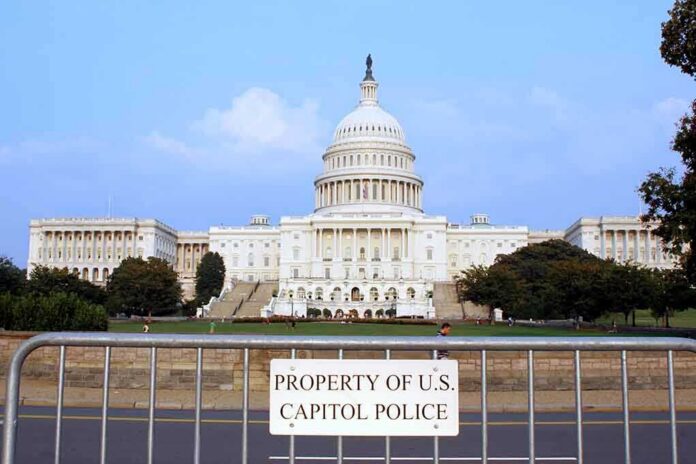
For the first time ever, Congress has used the War Powers tool to try to shut down a sitting Republican president’s Iran campaign, raising big questions about who really controls America’s war decisions.
Story Snapshot
- Senate passes Iran War Powers resolution 50–48 after House approval, a first in U.S. history.
- Four Republicans join Democrats, while two GOP leaders skip the vote, letting it squeak by.
- The measure is called “symbolic” by media and the White House, but it presses the War Powers Act.
- A fragile ceasefire and a secretive 14‑point Iran memorandum fuel doubts about who is telling the truth.
Senate Rebukes Trump With Historic Iran War Powers Vote
The United States Senate passed a concurrent resolution directing President Trump to stop military action in Iran or seek permission from Congress, with a tight 50–48 vote.[1] The House of Representatives had approved the same text earlier in the month, 215–208, with a few Republicans crossing over.[1] This marks the first time since the War Powers Resolution of 1973 that both chambers pushed through such a measure aimed at ending or formally authorizing a conflict.[1] That alone makes this vote a major constitutional moment, no matter how Washington tries to spin it.
Four Republican senators joined Democrats to pass the resolution: Rand Paul of Kentucky, Susan Collins of Maine, Lisa Murkowski of Alaska, and Bill Cassidy of Louisiana.[1] One Democrat, John Fetterman of Pennsylvania, broke with his party and voted no.[1] Two key Republican figures, Senate leader Mitch McConnell of Kentucky and Dave McCormick of Pennsylvania, did not vote at all, which cleared the path for the measure to pass by only two votes.[1] Their absence lets critics question how much real Republican support this resolution has, even as the media celebrates a “bipartisan rebuke” of Trump.
Is This Resolution Just Political Theater or a Real Limit on War Powers?
The War Powers Resolution of 1973 is a federal law meant to stop presidents from dragging the country into war without clear approval from Congress.[18] It says the president must tell Congress within 48 hours of sending troops into conflict and must end or get approval for those operations within 60 days, with a short extension only to safely wind down.[18][19] Supporters of the new Iran measure argue that, because both chambers passed a concurrent resolution under this law, President Trump is legally required to comply even without signing anything.[2] That view would strengthen Congress and limit the modern habit of endless wars started by executive power alone.
Major media outlets, however, call the new measure “symbolic” and stress that it does not go to the president for signature and does not become a normal statute that courts can easily enforce.[5][6] White House officials also claim the War Powers law is unconstitutional and say it cannot truly bind the president.[6] For conservative readers, the fight here is about process, not just policy: if Congress can ignore the Constitution and invent new ways to control the commander in chief, that is dangerous. But if presidents can keep ignoring written law and rules on war, that also erodes checks and balances the framers designed.
Ceasefire, Secret Memorandum, and the Question of Ongoing Hostilities
The administration points to an April 7, 2026 ceasefire with Iran to argue that there is no active war for Congress to shut down.[9] Reports describe a two‑week ceasefire that reopened the Strait of Hormuz and led the United States military to stop offensive operations while keeping defensive missions.[9] Israel is also reported to have halted airstrikes under the same arrangement.[10] The White House sent Congress the text of a 14‑point interim memorandum of understanding with Iran, which includes language about a permanent stop to military activities and commitments not to use force.[13][14] On paper, that looks like the end of hostilities, at least for now.
🇮🇱#Iran🇮🇷
A political blow to Trump:
After the House of Representatives, the U.S. Senate has also approved a measure stating that the president must end the war with Iran and withdraw American military forces from the Middle East. Because it is a Concurrent Resolution, it does…— Chaya Eitan (@ChayaEitan) June 24, 2026
Critics in Congress and in the media are not convinced that this memorandum is a true binding peace agreement, and they question why the administration still wants an extra $80 billion in war funding if the conflict is over.[1] Senator Catherine Cortez Masto has publicly asked why such a large supplemental request is needed in the middle of a ceasefire.[1] The White House itself calls the ceasefire “fragile” and says President Trump will “ultimately dictate” its timeline, suggesting things could heat up again quickly.[16][12] That language undercuts the claim that the war is truly ended and makes the War Powers debate more than a legal paperwork fight.
What This Means for Conservatives Who Care About the Constitution
For decades, presidents of both parties have pushed beyond their limits on war powers, while Congress has often talked tough but passed mostly symbolic resolutions.[22] Data from a long‑term War Powers study show that in 38 cases where presidents admitted introducing American forces into hostilities, 34 relied only on claimed executive power under Article II, not on a formal declaration or authorization from Congress.[22] That pattern is why many constitutional conservatives worry: unchecked war powers mean unchecked spending, more global entanglements, and less say for the people’s representatives. This new Iran vote fits that long story but adds a twist by directly telling a sitting president to stand down.
At the same time, many conservative voters will see this particular resolution as driven by partisan dislike of Trump rather than a real desire to fix war powers in a neutral way. The fact that Republican leadership sat out the vote, and that only four Republicans backed it, shows deep division on how to handle Iran and how far Congress should go in constraining the commander in chief.[1] The core constitutional question remains unsettled: can Congress, by concurrent resolution alone, order a president to stop using military force? Until a federal court clearly answers that, the War Powers law will stay in dispute, and future presidents—Republican or Democrat—will try to stretch their authority.
Sources:
[1] Web – Senate Passes Iran War Powers Resolution 50–48
[2] Web – Congress passes war powers measure for first time, rebuking … – BBC
[5] Web – Congress passes war powers resolution, offering rare rebuke of Trump
[6] YouTube – LIVE: US Senate Pass Resolution, Trump’s Iran War Powers Limited
[9] Web – BIG: The Senate passed a War Powers Resolution against Trump’s …
[10] Web – US and Iran agree to 2-week ceasefire as Trump pulls back on threats
[12] Web – White House shares Iran’s official statement confirming willingness …
[13] YouTube – White House says Trump hasn’t set ceasefire deadline for Iran
[14] Web – Read the US account of unreleased 14-point Iran ceasefire …
[16] Web – Addressing Threats to the United States by the Government of Iran
[18] Web – War Powers Resolution – Avalon Project
[19] Web – War Powers Resolution of 1973 | Richard Nixon Museum and Library
[22] Web – Then and Now: The War Powers Resolution (1973) and War Powers …
© newsalertdaily.org 2026. All rights reserved.