
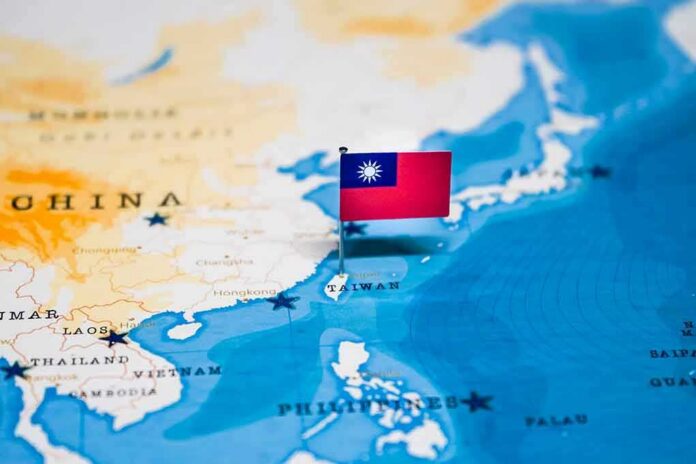
As China rolls out new laws it claims reach across borders, Taiwan’s president is warning that “red terror” from Beijing is not just rhetoric but a direct threat to a free society.
Story Snapshot
- Taiwan President Lai Ching-te told his ruling party they must resist Beijing’s “red terror” and keep Taiwan from becoming “China’s Taiwan.”
- Lai says Taiwan is a sovereign, independent nation and insists the Republic of China and the People’s Republic of China are not subordinate to each other.
- Beijing is using new legal tools, including an “Ethnic Unity” law, in what Lai describes as cross-border legal warfare against Taiwan’s people.
- China rejects Lai’s stance, repeating that Taiwan is part of China and calling his sovereignty claims “heresy” and “provocative.”
Lai’s “red terror” warning and what sparked it
President Lai Ching-te used a major party gathering to warn that Taiwan “must not become China’s Taiwan” and must stand together against what he labeled Beijing’s “red terror.” He was speaking to members of the Democratic Progressive Party, which has pushed a strong separate identity for Taiwan and rejects Beijing’s claim that the island is a Chinese province. Lai’s message was simple but stark: if Taiwan lets China’s pressure grow unchecked, its open, democratic way of life could be slowly strangled.
Lai tied his warning to China’s new “Law on Promoting Ethnic Unity and Progress,” arguing that it gives Chinese authorities a legal excuse to go after people beyond China’s borders. He described this as a form of legal warfare, saying Taiwan “will not accept the reach of red terror or united front infiltration into Taiwanese society.” For many Taiwanese, this lands on top of years of Chinese military drills and cyber attacks, raising fears that Beijing now wants courtroom tools to reach across the strait, not just missiles.
Taiwan’s sovereignty claim versus China’s one‑China line
Lai’s party speech fits a longer pattern: he has repeatedly said “democratic Taiwan is a sovereign, independent nation” and that the Republic of China and the People’s Republic of China “are not subordinate to each other.” In his inaugural address, he urged all parties in Taiwan to oppose annexation and never trade away sovereignty for political gain. He frames the island’s identity broadly, saying people may call it the Republic of China, Taiwan, or Republic of China Taiwan, but in each case it is still a self‑ruled country.
China’s leaders answer with their own firm line. Official spokespeople and state media say Taiwan has “always” been part of China and that the one‑China principle — one China, Taiwan as an inalienable part, and Beijing as the only legal government — is settled fact. After an earlier Lai speech where he said Taiwan is “of course” a country, Beijing called him “heretical” and “provocative” and accused him of spreading “heresy” about sovereignty. Chinese spokespeople insist that no matter what Lai says, he cannot change “historical and legal fact” as they see it.
Legal warfare, political warfare, and growing cross‑strait pressure
Lai’s “red terror” phrase echoes wider concerns that China now wages “political warfare” and legal warfare alongside military threats. Analysts describe united front work, media influence, economic leverage, and now new laws as parts of a strategy to weaken Taiwan’s will to resist and to paint any push for local identity as “separatism.” Lai’s government says it will set up a permanent task force to counter this, including “counter‑lawfare” and campaigns to explain Taiwan’s history and status to both its own citizens and the world.
China, for its part, has stepped up military exercises and harsh rhetoric whenever Taiwanese leaders talk more openly about sovereignty. After Lai’s election, Chinese forces ran larger drills around the island and repeated that reunification is “unstoppable.” This back‑and‑forth pushes ordinary Taiwanese into a tight spot: they must live daily life under the shadow of war games nearby and new rules in Beijing that may claim power over what they say and do, even though they never voted for China’s leaders.
Why this fight over words matters beyond Taiwan
Lai’s comments might sound far away to Americans, but they highlight a pattern many here now see at home: powerful governments using law and fear more than open debate to shape behavior. When one side writes rules that can reach across borders and punishes speech as “heresy,” it raises alarms for anyone who cares about free thought and self‑rule, whether in Taipei, Washington, or small towns across the Midwest. People on both the right and the left in the United States worry about elites using complex laws to control ordinary citizens; Lai is warning his people about something similar from abroad.
This clash also ties directly into American security and pocketbook concerns. The Taiwan Strait is a key path for global trade, including high‑tech goods and energy flows that affect prices here. Any crisis there could hit supply chains, raise costs, and drag U.S. forces into another major conflict while Washington still struggles with debt, border issues, and trust in its own institutions. Lai’s vow that only Taiwan’s 23 million people can decide their future echoes a core American idea: government should answer to the governed, not to distant power centers.
Sources:
youtube.com, taipeitimes.com, reuters.com, theepochtimes.com, globaltaiwan.org, english.news.cn, us.china-embassy.gov.cn, en.people.cn, aljazeera.com, usali.org, uscc.gov, crisisgroup.org, cfr.org, chrissmith.house.gov, asiacentre.eu
© newsalertdaily.org 2026. All rights reserved.