

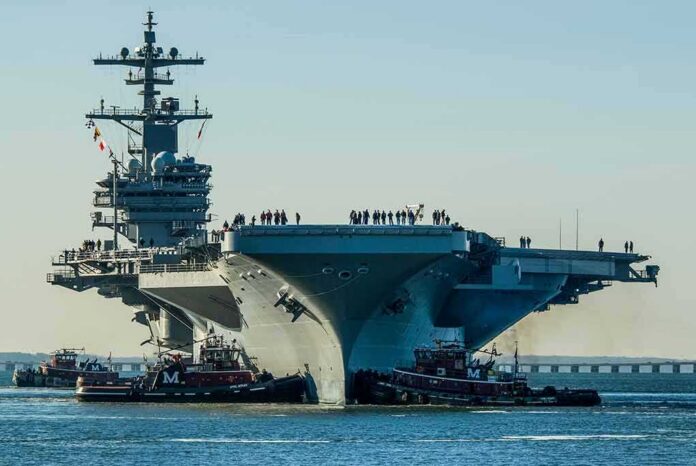
China plans to field up to nine aircraft carriers by 2035 while U.S. shipyards still struggle to deliver on schedule, exposing a growing industrial gap backed by official reports.
Story Snapshot
- Pentagon report says China targets six more carriers by 2035, for a total of nine.
- U.S. watchdogs say Navy shipyards face poor conditions, backlogs, and long fix timelines.
- Navy leaders and Congress hear that industrial capacity shortfalls hinder delivery goals.
- White House orders a plan to boost readiness and study a fifth public Navy yard.
What the Pentagon Says About China’s Carrier Ambitions
The Department of Defense’s 2025 China Military Power Report states that China’s navy aims to add six more aircraft carriers by 2035, bringing its total to nine. That target signals a sustained production push, not a one-off build. Open-source coverage built on the report describes three Chinese carriers in service and a fourth under construction, but the 20-month pace claim is not confirmed in the primary report. The key fact is the nine-carrier goal, which would expand China’s blue-water reach.
U.S. officials warn that China’s shipbuilding scale gives it an edge. Navy Secretary Carlos Del Toro said China’s shipbuilding and repair capacity “far exceeds America’s,” with some Chinese yards outpacing the combined output of key U.S. yards, underscoring a structural challenge the United States must answer. This is less about one launch date and more about industrial depth. It reflects how China’s state-driven model can mass-produce hulls faster than U.S. industry can adapt.
What U.S. Watchdogs Say About America’s Shipyards
Government Accountability Office reviews have flagged shipyard problems for years. One report detailed poor facilities and equipment, a multibillion-dollar backlog, and timelines measured in decades to restore capability. Another found that maintenance delays for aircraft carriers and submarines stem from workforce shortfalls and yard capacity, among other factors. These are not partisan talking points. They are audit findings that show how aging yards and thin staffing slow work on the fleet we already have.
A separate Government Accountability Office review of shipbuilding found the Navy’s plan leaned on capacity that had not yet been achieved. It concluded that none of the seven builders of battle-force ships were positioned to meet the Navy’s delivery goals at the time of the report. That includes supplier bottlenecks, not just final assembly yards. These gaps feed schedule slips, cost growth, and fewer ships ready for deployment, which troubles both hawks and doves worried about waste and risk.
Policy Moves: Spending, A New Yard, and Industry Limits
The White House directed the Secretary of the Navy to submit a plan to raise readiness for nuclear-powered submarines and aircraft carriers. The order calls for tapping private-sector capacity and studying a fifth public Navy yard. It also asks for analysis of drydock capacity, potential locations near the Pacific Fleet, financing options, and timelines with resources to match. The memo admits a hard truth: the current industrial base is not enough for the mission.
On Capitol Hill, a Congressional Research Service statement to the House Armed Services Committee said capacity limits exist at shipyards and suppliers, with the worst pain in submarine building and strain also hitting surface-ship construction. Industry leaders are pushing steadier demand to rebuild skills and lines. A major shipbuilder urged buying carriers two at a time, with advance funding and predictable spacing, to stabilize workload and rebuild the workforce over years, not months.
Why This Matters for Voters Across the Aisle
For many Americans, this story validates a broader worry: powerful institutions promised readiness but let core factories wither. Conservatives see waste, red tape, and dependence on shaky supply chains. Liberals see misaligned priorities, underinvestment in workers, and a shrinking ladder to middle-class trades. Both sides see a government that reacts late. The audits show the fix will take money, time, and focus. The alternative is a larger gap that others abroad will try to exploit.
What We Know—and What We Do Not
We know China’s goal of nine carriers by 2035 is in the Pentagon’s report, and U.S. yards face capacity and condition problems that slow delivery. We do not have clean, apples-to-apples data proving China is launching a new carrier every 20 months. Some claims about the fourth Chinese carrier rely on open sources rather than primary documents. But the trend line is clear: China is building momentum, and the United States must rebuild its yards to keep pace.
Sources:
19fortyfive.com, andrewerickson.com, gao.gov, meta-defense.fr, treadstone71.com, news.usni.org
© newsalertdaily.org 2026. All rights reserved.