

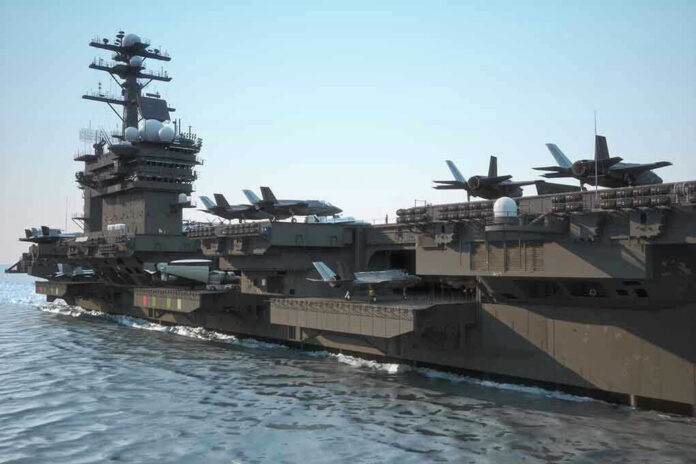
America’s $13 billion flagship aircraft carrier USS Gerald R. Ford endures busted toilets and sailors desperate to quit after a grueling 300-day deployment, exposing the human cost of endless global overstretch under prior administrations now mercifully behind us.
Story Snapshot
- USS Gerald R. Ford exceeds 300 days at sea, potentially reaching 11 months, shattering U.S. Navy deployment records amid Venezuela and Iran operations.
- Chronic sewage system failures average one maintenance call per day, with 42 external assists since 2023 and costly $400,000 acid flushes.
- Over 4,600 sailors face morale collapse, missing family deaths and considering quitting due to fatigue and sanitation nightmares.
- President Trump’s forces captured Venezuelan tyrant Nicolás Maduro in January 2026, showcasing decisive action after years of weak leadership.
- Navy downplays issues as “isolated,” but reports reveal risks to readiness against Iran threats in the Middle East.
Record-Breaking Deployment Pushes Navy to the Brink
USS Gerald R. Ford departed Naval Station Norfolk on June 24, 2025, for what became an unprecedented odyssey. Operations shifted to U.S. Southern Command for counternarcotics and culminated in January 2026 strikes capturing Nicolás Maduro. By early 2026, Middle East tensions with Iran extended the mission, surpassing 240-300 days at sea. Docking in Haifa, Israel, in February 2026, the carrier now eyes an 11-month total, far beyond standard six-month peacetime runs. This high-tempo strain echoes globalist overcommitments conservatives warned against for years.
Sewage System Failures Plague $13 Billion Flagship
The Ford-class innovator, commissioned in 2017 at $13 billion, features the VCHT vacuum sewage system for water conservation. Narrow pipes, borrowed from cruise ships, clog under 4,600 crew loads, averaging one daily maintenance call. Since 2023, 42 external assists occurred, including 32 in 2025 alone. January 2026 saw 205 breakdowns in four days during Maduro ops. Costly $400,000 acid flushes and 19-hour engineering shifts highlight design flaws unfit for warships. Navy claims repairs take 30 minutes to two hours with no mission impact.
Sailor Morale Crumbles Amid Family Separations
Over 4,600 sailors endure exhaustion, missing family deaths and milestones, fueling quit intentions. Reports from Wall Street Journal and Navy Times detail morale dips from fatigue and overflowing toilets. Precedents like USS Harry S. Truman’s 2025 eight-month Red Sea deployment, which caused jet losses, warn of safety risks. Norfolk homeport families suffer most. This human toll underscores how prolonged deployments erode retention, hurting recruiting in an already strained Navy vital for deterring foes like Iran.
Navy Response and Expert Warnings
Lt. Cmdr. David Carter of U.S. Fleet Forces Command insists issues improve and remain isolated, independent of operations. Retired Rear Adm. Mark Montgomery notes an 11-month run would shatter records, exceeding typical overruns. Critics question VCHT suitability for combat loads versus civilian use. Amid dual-carrier presence with USS Abraham Lincoln off Iran, vulnerabilities rise. Taxpayers demand accountability for this $13 billion asset projecting American strength under President Trump’s resolute leadership.
Short-term fatigue risks errors; long-term, retention plummets and design flaws delay fixes. Political scrutiny grows on readiness as Indo-Pacific pivots strain fleets. Conservatives celebrate Maduro’s capture as proof of restored might, but basic failures remind us limited government means smart investments, not endless entanglements.
Sources:
Sewage crisis hits USS Gerald R. Ford aircraft carrier: Report
The Navy’s largest ship continues to be plagued by plumbing issues
The heavy toll of the Iran mission on USS Gerald R. Ford