
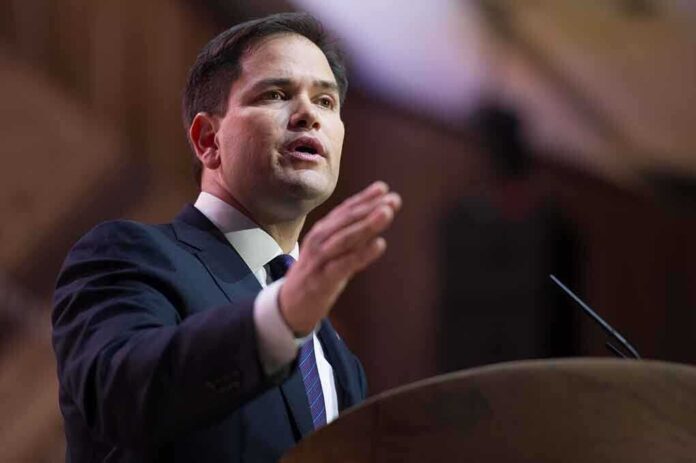
Congressional gridlock has left President Trump with virtually unchecked authority to launch direct military action against Venezuela, as Marco Rubio stands poised to drive a dramatic escalation that could reshape American power and constitutional balance.
Story Highlights
- Senate failed twice to restrict Trump’s war powers, enabling potential direct strikes on Venezuelan territory.
- Rubio’s leadership at State Department signals a hardline shift—regime change openly discussed as a goal.
- Military buildup reaches levels unseen in the Caribbean for decades, triggering national security and constitutional concerns.
- War on Drugs cited as justification, but many experts and critics see it as a pretext for broader intervention.
Rubio and Trump Chart Aggressive New Course for Venezuela
President Trump, emboldened by a divided Congress, now wields unprecedented latitude to take military action against Venezuela. After two failed Senate resolutions to limit presidential war powers, Secretary of State Marco Rubio has emerged as a linchpin in shaping this new approach. The administration’s public messaging frames ongoing strikes as counter-narcotics operations, yet official discussions increasingly point to regime change as the true objective. This escalation marks the largest US military buildup in the Caribbean in decades, raising alarms for constitutional checks and balances as well as the future of America’s role in the region.
The administration’s swift evolution from anti-drug operations to targeting Venezuelan land assets signals a readiness for direct confrontation. The deployment of Navy warships and the aircraft carrier Gerald Ford demonstrates the seriousness of this posture. Rubio, long a vocal critic of Maduro’s regime, has publicly advocated for expanded operations, and recent intelligence reports suggest US planners have already identified Venezuelan land targets. Meanwhile, Maduro’s government alleges the capture of CIA-aligned mercenaries, further fueling tensions and uncertainty about next steps.
Congressional Checks Erode, Constitutional Questions Loom
Legislative efforts to curb executive war powers have repeatedly failed, leaving the Trump administration free to act under its interpretation of the War Powers Resolution. Congressional Democrats, led by figures like Tim Kaine and Adam Schiff, warn of a constitutional crisis and the risk of entangling the US in another open-ended conflict. The erosion of checks and balances is especially troubling to Americans who value limited government and the integrity of the Constitution. With at least 69 fatalities reported from 17 strikes, the gravity of unchecked executive action is no longer theoretical—it is a matter of life and death, with consequences for US service members and Venezuelan civilians alike.
Some opposition voices within Venezuela support US intervention as a means to oust Maduro, while international bodies such as the UN and OAS have condemned the strikes as illegal and destabilizing. The domestic response is sharply polarized, with critics arguing that the administration’s anti-narcotics rationale masks a broader agenda of regime change. Legal scholars and human rights groups raise alarms about compliance with international law, and the precedent set by bypassing congressional approval could reverberate well beyond this crisis.
Escalation Risks and Long-Term Implications for US Power and Values
The shift toward direct strikes and regime change ambitions in Venezuela has far-reaching implications for American power, constitutional order, and conservative principles. In the short term, the move increases the risk of direct military confrontation and further destabilization in the region, with potential for civilian casualties and humanitarian crises. Over the long term, this episode sets a dangerous precedent for expanded presidential war powers, threatening the separation of powers so central to American governance. Regional neighbors, the US military, and humanitarian groups will all feel the effects, while oil markets and trade routes face uncertainty. For conservative Americans, the stakes are clear: unchecked executive action erodes constitutional safeguards, and any intervention must be rigorously justified, transparent, and aligned with core national interests.
Expert analysis underscores the risks of escalation and unintended consequences. Security analysts warn that the rapid shift from anti-narcotics missions to open regime change could entangle the US in a protracted conflict. Human rights organizations argue that civilian harm and legal violations must be weighed against any potential gains. Ultimately, the Trump administration’s approach in Venezuela is a critical test of both America’s resolve and its commitment to constitutional and conservative values. With Congress sidelined and Rubio at the helm, the nation faces momentous decisions that will shape its future role on the world stage—and the integrity of its founding principles.
Sources:
Senate GOP Kills Bill That Would Block Trump Boat Bombings and War on Venezuela
2025 United States military strikes on alleged drug traffickers
US Threats Against Venezuela: The Tricontinental Institute for Social Research