

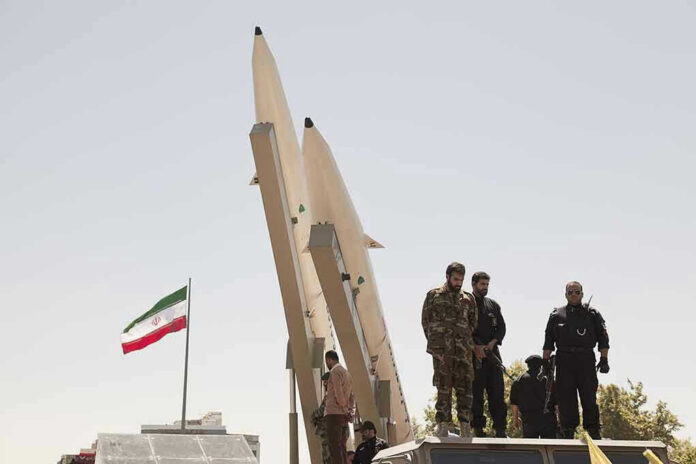
New intelligence shows the Iranian regime still has most of its missile force intact, keeping American troops, Israel, and global shipping lanes squarely in the crosshairs.[5]
Story Snapshot
- U.S. and allied strikes shredded parts of Iran’s arsenal, but Tehran still holds a large missile stockpile and many launchers.[1][5]
- Conflicting reports now say anywhere from one‑third to over two‑thirds of Iran’s missiles survived, proving the threat is far from over.[1][13]
- Iranian commanders boast they are restoring launch sites and refilling missile depots during the ceasefire.[14][15]
- Experts warn U.S. missile defenses are under strain after heavy use in the Iran war, creating a dangerous window if conflict spreads.[6][20][26]
Iran’s Missile Arsenal: Degraded, But Still Dangerous
Before the latest war, Western and Israeli estimates put Iran’s ballistic missile inventory in the low thousands, with around 2,500 long‑range systems and more than 3,000 missiles overall.[3][23] Israeli operations in earlier rounds of fighting claimed to destroy roughly half of Iran’s missile stockpiles, yet even those estimates still left Tehran with about 1,500 missiles and 200 launchers.[4] American intelligence has long said Iran holds the largest ballistic missile arsenal in the Middle East, able to hit targets up to 2,000 kilometers away, including Israel and U.S. bases.[8][9]
Since U.S. and Israeli forces began the most recent air campaign, think tank and media assessments suggest Iran may have lost about one‑third to one‑half of its ballistic missiles and roughly half of its launchers.[1][2] A Reuters assessment says Washington is confident about eliminating one‑third of the stockpile, with another third damaged, destroyed, or buried in tunnels and bunkers.[13] Even that “good news” still implies Iran has a substantial arsenal left and could dig out or repair many missiles once bombing pauses.[13]
New Intelligence: Most Launch Sites Back Online
Recent classified reporting, leaked through outlets like The New York Times and Middle East Eye, undercuts any victory laps in Washington.[5][12] U.S. intelligence now says Iran still fields about 70 percent of its mobile launchers and has retained roughly 70 percent of its prewar missile stockpile.[5] Additional reporting indicates Tehran has regained operational access to around 30 of 33 missile sites along the Strait of Hormuz and roughly 90 percent of its underground missile tunnels and storage facilities.[11][12] That means it can still threaten U.S. warships and world oil flows in a crisis.[11]
Iranian forces have already shown how they use this “lingering launch capability.” During the fighting, Tehran launched hundreds of ballistic missiles and drones at Israel, Gulf states, and American positions, while still holding back enough weapons to keep firing.[3][23][24] Analysts describe a race: U.S. and Israeli strikes try to burn down Iran’s launch capacity before Western missile defenses run low, while Iran meters out salvos to preserve its arsenal for future leverage.[7][23] So far, Iranian launch rates have dropped sharply, but not disappeared, which fits a strategy of conserving missiles rather than proof of collapse.[7][22]
Mullahs Boast of Rebuilding as U.S. Stocks Run Down
Inside Iran, the Islamic Revolutionary Guard Corps is using the ceasefire to send a very different message to its own people and the region.[14] Iranian state‑linked outlets show commanders touring missile halls and tunnels, claiming that maintenance and refilling of missile and drone launch platforms is moving faster now than before the war.[14][15] Independent experts caution that much of what we see looks like repairing tunnels, reopening storage sites, and shuffling existing weapons, not mass production of brand‑new missiles.[14] Even so, that work helps Iran recover access to buried stockpiles.
One post‑ceasefire assessment based on intelligence reporting says Tehran has already restored about 100 launcher systems that were trapped in damaged underground facilities, bringing it back to around 60 percent of prewar launcher capacity.[15] The same analysis warns Iran could regain access to roughly 70 percent of its prewar ballistic missile arsenal, or about 2,000 missiles, if recovery continues.[15] Put simply, years of Western sanctions and half‑measures did not stop Iran from building a huge missile force, and weeks of airstrikes have not been enough to break it.
What This Means for American Security and the Next Crisis
While Iran digs out missiles, the United States has been burning through its own stockpiles to defend bases, allies, and shipping.[6][20][22] A detailed study from the Center for Strategic and International Studies finds that key U.S. munitions like Patriot and THAAD air defense interceptors, Tomahawk cruise missiles, and Precision Strike Missiles have been heavily used and will take at least three years to rebuild on a “wartime footing.”[6][20] Internal assessments leaked to the media warn of a “near‑term risk” if another major conflict erupts before industry catches up.[26]
Marine Corps and Navy‑linked analysis also shows how U.S. forces used hundreds of Standard Missile interceptors in the Red Sea and to shield Israel from missile barrages since 2023.[21][22] The Heritage Foundation data cited in those reviews suggest double‑digit percentage cuts in some high‑end interceptor inventories, even before the latest Iran war drew down more stocks.[21][25] Pentagon leaders insist America still has “enough for this conflict,” but they also admit that prewar inventories were already too low for a prolonged fight against a peer like China.[7][25]
Sources:
[1] Web – MULLAHS KEEP MISSILES
[2] Web – How many long-range ballistic missiles does Iran have left? – Reddit
[3] Web – [PDF] Iranian Ballistic Missile Estimates | JINSA
[4] Web – Ballistic missile program of Iran – Wikipedia
[5] Web – Table of Iran’s Missile Arsenal | Iran Watch
[6] Web – U.S. Intelligence Shows Iran Retains Substantial Missile Capabilities
[7] Web – Last Rounds? Status of Key Munitions at the Iran War Ceasefire – CSIS
[8] Web – Analysis: Why Iran’s ballistic missile launches are declining
[9] Web – What Are Iran’s Nuclear and Missile Capabilities?
[11] Web – Iran Arsenal Tracker — Every Weapon System in Iran’s Military
[12] Web – Iran retains access to majority of missile launch sites, US …
[13] Web – Iran has regained access to most missile and underground sites, US …
[14] Web – Exclusive: U.S. can only confirm about a third of Iran’s missile …
[15] Web – Iran’s Missiles After the Ceasefire – الحرة
[20] Web – [NYT] U.S. Intelligence Shows Iran Retains Substantial Missile …
[21] Web – Iran Conflict Drains Critical US Missile Stockpiles, New Report …
[22] Web – US missile depletion from Houthi, Israel conflicts may shock you
[23] Web – How depleted weapons stockpiles could affect the Iran conflict – BBC
[24] Web – Middle East Special Issue: March 2026 – ACLED
[25] Web – Middle Eastern crisis (2023–present) – Wikipedia
[26] YouTube – War in Iran is Chewing Through American Missile Stockpiles
© newsalertdaily.org 2026. All rights reserved.