
After failed peace talks, President Trump is betting that a hard maritime blockade—and a blunt warning to Iran’s fast boats—can stop what the U.S. calls extortion in one of the world’s most critical oil chokepoints.
Quick Take
- President Trump warned Iran’s remaining “fast attack ships” would be “immediately eliminated” if they approach the U.S. blockade.
- U.S. Central Command confirmed enforcement against vessels to and from Iranian ports across key waterways, while allowing non-Iranian port traffic to pass through the Strait of Hormuz.
- The blockade follows marathon U.S.-Iran talks in Islamabad led by Vice President JD Vance that failed to produce a peace deal.
- Conflicting statements emerged about allied involvement, with U.K. messaging emphasizing navigation protection but denying blockade participation.
Trump’s Warning Targets Iran’s Fast Boats as Blockade Begins
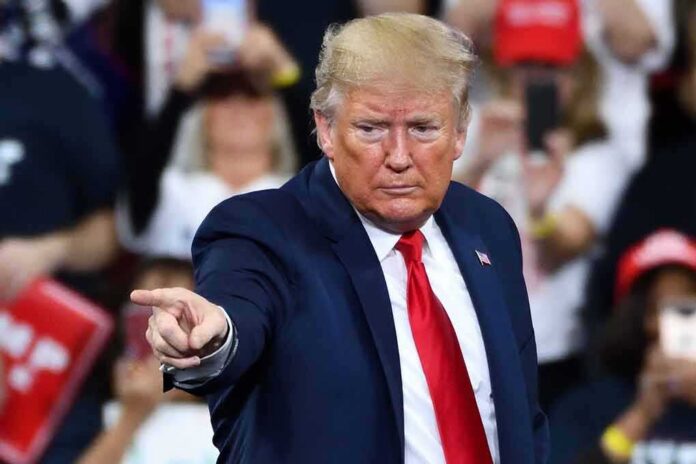
President Donald Trump issued a public warning that Iran’s remaining “fast attack ships” would be “immediately eliminated” if they move toward a new U.S. maritime blockade tied to Iranian ports and the Strait of Hormuz. The warning followed the administration’s announcement that the U.S. Navy would interdict vessels connected to Iranian port traffic after diplomacy collapsed. The message was designed to deter close-in harassment or swarm tactics that have historically threatened commercial shipping in the region.
U.S. Central Command confirmed the operation’s scope as enforcement on vessels traveling to or from Iranian ports in the Arabian Gulf, Gulf of Oman, and Arabian Sea. Reporting also described the approach as something short of a total shutdown of Hormuz, with non-Iranian port traffic permitted to transit the strait. That distinction matters because a full closure would likely trigger even sharper global energy disruptions and raise immediate pressure on U.S. allies dependent on Gulf shipping lanes.
Diplomacy Collapsed in Islamabad, and the Military Plan Filled the Vacuum
Vice President JD Vance led marathon U.S.-Iran talks in Islamabad that failed to produce a peace agreement, setting the stage for escalation at sea. After the breakdown, Trump announced the blockade and described an expanded enforcement posture that includes intercepting ships accused of paying Iranian tolls and addressing mines reportedly laid in the strait. The administration framed these steps as necessary to stop coercion against international shipping rather than an attempt to punish neutral commerce.
Reporting described Iran’s toll system as payments demanded for “safe passage,” including claims that some tolls were denominated in Chinese yuan. U.S. officials and allied maritime services also discussed safety measures for noncombatant shipping, including limited windows for neutral vessels that might be in Iranian ports to depart before enforcement tightens. In practical terms, the first days of any blockade often become a test of procedures—rules of engagement, boarding authority, and deconfliction—before they become a test of nerves.
Why the Strait of Hormuz Still Has Washington on Edge
The Strait of Hormuz remains a strategic choke point for global energy, often cited as handling roughly one-fifth of the world’s oil flows. When traffic through Hormuz slows or becomes riskier, prices can jump quickly, insurance costs rise, and supply chains absorb new shocks. For American families already sensitive to inflation and energy costs, that vulnerability is not abstract. It is one reason administrations of both parties have treated freedom of navigation there as a core national interest.
Allies, Messaging Gaps, and the Risk of Miscalculation
Public messaging introduced uncertainty about who is doing what, and that uncertainty can add risk in a crowded maritime theater. Reports highlighted a contradiction between Trump’s references to U.K. assets and U.K. statements emphasizing a broader coalition to protect navigation while denying participation in a blockade. Even when allies share the goal of safe passage, differences over tactics—blockade versus escort, interdiction versus monitoring—can complicate coordination and create openings for adversaries to test boundaries.
Trump warns Iran boats breaching US blockade will be 'eliminated' | AFP https://t.co/WPu3L2jNyN via @YouTube
— Kennedy CK (@KennedyCKk4) April 13, 2026
For domestic politics, the episode lands in a familiar place: many conservatives want decisive action to protect commerce, deter state-backed coercion, and keep energy markets stable, while many liberals worry about escalation and humanitarian spillover. The available reporting supports one clear conclusion: the administration is using military leverage after diplomacy failed, while trying to avoid a complete closure of Hormuz. Whether this approach reduces long-term risk or raises it will depend on enforcement discipline and Iran’s response.
Sources:
https://www.cbsnews.com/news/trump-strait-of-hormuz-blockade-iran/
https://www.cbsnews.com/live-updates/iran-war-us-iran-ports-blockade-strait-of-hormuz-trump/