
China nearly armed Iran with a Mach 4 supersonic missile capable of destroying U.S. aircraft carriers, exposing Beijing’s willingness to endanger American naval forces and violate international sanctions while brazenly denying the entire deal.
Story Snapshot
- Reuters confirmed China was finalizing a deal to sell Iran the CM-302 supersonic anti-ship missile, capable of Mach 4 speeds and evading U.S. Navy defenses
- Beijing flatly denied the arms sale despite six intelligence sources confirming negotiations were near completion
- The missile deal would violate UN arms embargo restrictions reimposed in September 2025
- Defense analysts warn the carrier-killer poses a direct threat to U.S. naval assets in the Persian Gulf and Strait of Hormuz
China’s Carrier-Killer Deal With Iran Exposed
Six intelligence sources confirmed to Reuters in February 2026 that China was finalizing a contract to provide Iran with CM-302 supersonic anti-ship missiles, the export variant of China’s YJ-12 system. The CM-302 reaches Mach 4 speeds, carries a 440-pound warhead, and can strike targets up to 180 miles away while skimming just above the ocean surface to evade detection. Defense analyst Reuben F. Johnson, a 36-year expert and Department of Defense consultant, detailed how the missile’s terminal maneuvering capabilities make it exceptionally dangerous against U.S. Navy vessels, potentially overwhelming current defense systems like the Phalanx Close-In Weapon System.
Beijing’s Suspicious Denial Contradicts Intelligence Reports
China’s Foreign Ministry dismissed the Reuters report as “not true” on February 24, 2026, despite overwhelming evidence from multiple sources confirming the deal’s existence. Negotiations had been underway for at least two years and accelerated dramatically following the 12-day Israel-Iran war in June 2025. Senior Iranian officials, including Deputy Defense Minister Massoud Oraei, made multiple visits to China during the talks. The timing of Beijing’s denial coinciding with U.S.-Israel air strikes on Iran starting February 28 raises serious questions about China’s credibility and intentions in arming a regime hostile to American interests.
Strategic Threat to U.S. Naval Operations
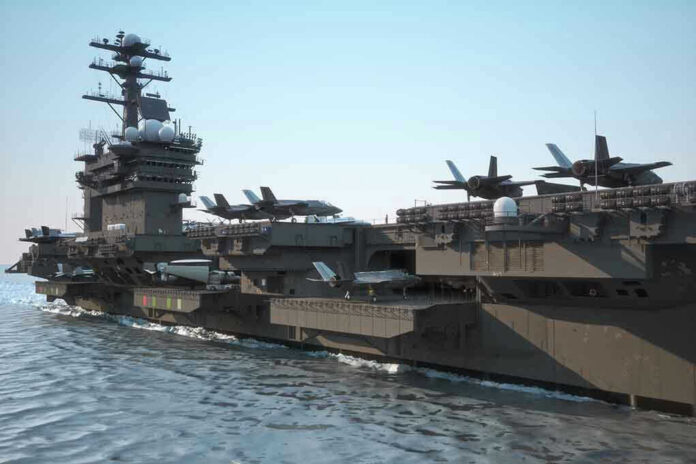
The CM-302 missile system represents a game-changing weapon that would fundamentally alter the balance of power in the Persian Gulf region. Iran sought the advanced missiles to offset losses from its June 2025 conflict with Israel and to threaten U.S. carrier groups operating near the Strait of Hormuz. President Trump has deployed the USS Abraham Lincoln and USS Gerald R. Ford to the region amid escalating tensions over Iran’s nuclear program. The missile’s sea-skimming capability and supersonic speed create a particularly difficult intercept scenario, challenging even advanced Aegis defense systems designed to protect carrier strike groups from aerial threats.
China’s Pattern of Arms Proliferation
China has already exported the CM-302 system to Pakistan, Algeria, and Serbia, demonstrating Beijing’s willingness to spread advanced weapons technology to nations seeking capabilities against Western naval forces. Pakistan deployed the missiles on Tughril-class frigates between 2021 and 2023, while Algeria acquired coastal defense variants in 2024. The CM-302 derives from Soviet-era Kh-31P technology that China adapted and scaled up through its YJ-91 and YJ-12 programs. China Aerospace Science and Industry Corporation markets the weapon specifically as a carrier-killer designed for use against large warships, making clear the system’s intended purpose against American naval assets.
China Almost Sold Iran a Mach 4 Carrier-Killer Missile — and Beijing Is Lying About Ithttps://t.co/yFJ2BpEzb7
— 19FortyFive (@19_forty_five) March 17, 2026
The proposed Iran deal violated the UN arms embargo reimposed in September 2025, yet negotiations proceeded with apparent disregard for international restrictions. While the deal appears stalled following U.S.-Israel military action in late February 2026, the episode reveals China’s strategic calculus prioritizing energy security and regional influence over responsible arms control. This directly threatens American servicemembers, undermines decades of nonproliferation efforts, and demonstrates why the Trump administration’s firm stance on China remains essential to protecting U.S. interests and maintaining naval superiority in critical waterways.
Sources:
China Almost Sold Iran a Mach 4 Carrier-Killer Missile — and Beijing Is Lying About It – 19FortyFive
China close to giving Iran a ship killer as US carriers close in – Asia Times
Iran nears China anti-ship supersonic missile deal as US carriers mass in region: report – Fox News
Iran Nears Deal for Chinese Supersonic Missiles, Posing New Threat to U.S. Navy – Modern Diplomacy
Iran Nears Deal to Buy Supersonic Anti-Ship Missiles from China – Iran Watch