

El Salvador’s stunning crime plunge under President Nayib Bukele is forcing a hard question the U.S. can’t dodge: how do you crush violent gangs without crushing constitutional protections in the process?
Story Snapshot
- Bukele’s March 2022 “state of exception” drove mass arrests and a dramatic homicide decline, but it also suspended key due-process protections.
- Authorities have detained more than 84,000 people over roughly three years, while the government acknowledges some innocent detentions and reports thousands of releases.
- The CECOT mega-prison, built for up to 40,000 inmates, symbolizes the “mano dura” model now watched across the region.
- Human-rights groups argue arrests and prison conditions have crossed legal and humanitarian lines, while many Salvadorans credit the crackdown for restored daily life.
Bukele’s Security Model: Exception Powers, Mass Arrests, and a Historic Homicide Drop
El Salvador’s crackdown accelerated after gangs killed 87 people in three days in March 2022, prompting Bukele to declare a “state of exception” that reduced constitutional protections and expanded arrest powers. Over the following months, detentions surged, eventually surpassing 84,000. Multiple reports cited a steep homicide decline over the last decade, with 2024 listed near 1.9 per 100,000, and officials crediting the policy for dismantling gang control of neighborhoods.
Security gains are reflected in official and widely cited figures: the 2022 homicide total fell sharply to 496, and the government framed the shift as a decisive break from years when MS-13 and Barrio 18 dominated territories through extortion and intimidation. Before Bukele, El Salvador’s homicide rate was among the world’s worst, with previous governments trying truces and partial enforcement that critics say failed to restore order or protect ordinary families and small businesses from predatory street-level rule.
CECOT and the Scale of Incarceration: What “Mano Dura” Looks Like in Practice
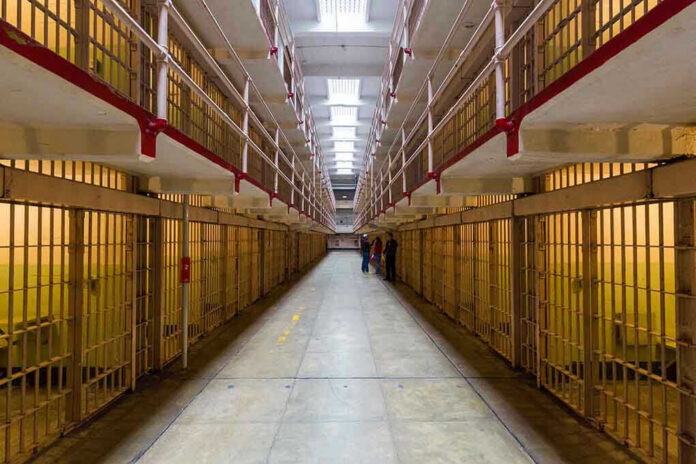
The crackdown’s most visible infrastructure is CECOT, a “mega-prison” opened in early 2023 with a stated capacity of 40,000. Its construction and use underscore the campaign’s scale: at points, estimates suggested roughly 2% of the adult population was incarcerated, an extraordinary figure by international standards. The government’s approach paired expanded policing and military deployments with aggressive detention policies designed to break gang logistics, recruitment, and intimidation.
From a law-and-order perspective, the model highlights a reality many Americans recognize: when the state fails to maintain basic security, ordinary liberty can become theoretical. At the same time, the state of exception has been renewed repeatedly—more than 35 times—raising a constitutional concern conservatives understand well. Emergency powers that begin as temporary can become normalized, and the long-term risk is that “exceptional” rules replace standard legal protections permanently.
Due Process, Innocent Detainees, and the Burden of Proof
Critics, including Human Rights Watch, have documented allegations of arbitrary arrests and poor prison conditions, arguing the crackdown’s breadth has swept up people without adequate evidence or meaningful access to defense. Bukele has publicly acknowledged that some innocents were detained and has said his government intends to release innocent people. Public reporting has also cited thousands of releases, reflecting both the scale of initial arrests and the difficulty of sorting suspects from noncombatants quickly.
The core dispute is not whether gangs were real—Salvadorans lived under their rule for years—but whether the process used to defeat them respected basic rights. For Americans, this is the central takeaway: the same tools that can dismantle organized criminal control—rapid detention, lowered evidentiary standards, and restricted legal challenge—are the tools that can erode civil liberties if copied without limits. The evidence base in available reporting shows both outcomes operating at once.
Why Washington Is Watching: Migration, Deportations, and the Trump-Bukele Relationship
El Salvador’s security turnaround intersects with U.S. policy because gangs, migration, and deportations are inseparable across the region. Reports cited a Trump-Bukele arrangement in early 2025 involving U.S. deportees, signaling a more direct alignment between Washington and San Salvador than during the prior era of frequent U.S. criticism and sanctions tied to alleged dealings with gangs. Bukele also faced U.S. allegations about secret pacts—claims he has denied—illustrating ongoing uncertainty about earlier back-channel dynamics.
For a U.S. audience exhausted by years of porous borders and soft-on-crime messaging, El Salvador’s results are hard to ignore. But the American system is built on constitutional guardrails precisely because “ends justify the means” thinking can metastasize into government overreach. The strongest lesson may be this: a state that cannot control violent criminal organizations is failing its citizens, yet a state that controls crime by suspending routine rights risks changing the character of its republic.
Limited public data in the provided research leaves open key questions, including the full criteria used for arrests, the evidentiary thresholds applied over time, and how consistently releases have tracked verified innocence versus administrative review. What is clear is that Bukele has delivered measurable security improvements alongside a governing model that relies on repeated emergency renewals. That combination is why the crackdown is praised as effective and criticized as rights-eroding—often by different observers looking at the same set of facts.
Sources:
From Murder Capital to Security State: El Salvador’s Transformation Under President Bukele
Scenarios for Bukele’s El Salvador
Bukele’s Gang Violence Crackdown in El Salvador
World Report 2025: El Salvador
Country policy and information note: fear of gangs, El Salvador (December 2025)